
The Bettii Pod Ltd – Revolutionising Menstrual Care
Background
The Bettii Pod Ltd, founded in 2021 by CEO Elaine Galston, is a start-up dedicated to normalising and destigmatising periods while promoting sustainable menstrual practices and enabling access to the testing of menstrual blood for key female focused health concerns. Focused on creating an away-from-home infrastructure for the management of reusable sanitary wear, the company aims to address challenges faced by users of reusable menstrual products, specifically the lack of facilities for cleaning and sanitising menstrual cups and discs in away-from-home environments.
1.8 billion people have periods, leading to 100 billion soiled single use period products being disposed of every year. These products are over 90% plastic and take over 500 years to decompose. The planet cannot support this. Reusables is the largest growth sector in the menstrual market with an estimated 64 million menstrual cups sold per annum with a 56% growth prediction.
The Challenge
The primary challenge being addressed by The Bettii Pod Ltd relates to the absence of convenient facilities for cleaning reusable menstrual cups in public spaces, an issue deemed such an obstacle that it was raised by the UN in a 2021 report which implored governments across the world to consider how to enable access to water within female toilets for menstrual cup cleaning. This obstacle, together with the lack of awareness and understanding of menstrual reusables, hinders the widespread adoption of sustainable menstrual products, affecting issues such as period poverty, environmental sustainability and at-home health testing adoption.
Currently menstrual cup users either do not clean their cup or use bottled water and/or disposable wipes which is not good for health, for the environment or practical. Over 23% drop their cup down the toilet or on the floor. The intended purpose of the Bettii product is to support sustainable menstrual practices, enabling eco-friendly menstrual product adoption and mitigating health concerns related to inadequate washing facilities. This gives potential users confidence to adopt cost saving reusables thereby helping eradicate period poverty and enabling access to the market for at-home testing of menstrual blood for key health concerns.
The company’s innovative solution was to develop an installable menstrual cup washer and sanitiser within toilet cubicles of various public locations, such as offices, gyms, cinemas, stadiums, airports, tourist attractions and other public infrastructures.
The Solution
Interface introduced The Bettii Pod Ltd, together with their designers Fearsome Ltd, to West College Scotland and with the help of Innovation Voucher Funding, the project to develop the world’s first menstrual cup washer and sanitiser for away-from-home environments was born. The collaboration involved extensive research, design, review of key, potentially limiting regulations, and the creation of a lab-based prototype.
The project looked at designing an installable sanitary washer, identifying related infrastructure requirements, and developing installation training. The outcome of the initial phase is the process design of a sanitary menstrual cup washer with the potential for global installation.
The partnership utilised the technical expertise of the College and active engagement from Bettii Pod’s product development team to design a prototype and toolkit, laying the foundation for commercial viability. The academic team’s support filled crucial gaps in electrical and plumbing expertise, providing insights into design alterations’ impact on sustainability and compliance with standards. This collaborative effort ensures the product’s alignment with industry standards and efficient installation requirements.
The support from the technical academic staff became invaluable providing crucial insights into the entire design process, from the conceptual stage to compliance and manufacturing. Their expertise was particularly beneficial in assessing how design alterations could positively impact sustainability, with a specific focus on Ingress Protection (IP) which determines the different degrees of protection of the enclosures of electrical and electronic equipment against external elements, IK rating which is defined in international standards and indicates a product’s resistance to mechanical impact, and Water Regulations Approval Scheme (WRAS) compliance.
This unique contribution filled a critical gap in Bettii Pod’s capabilities, ensuring that the product design would meet the necessary standards and considerations for long-term success. The academic team’s input was instrumental in addressing challenges that could not be sourced elsewhere or managed internally, highlighting the pivotal role they played in the development of the project.
The lab prototype was developed, eradicating key operational and installation barriers giving the Company much needed assurance as to the commercial applicability of their innovation.
This product boasts a pioneering design that sets it apart as the first of its kind, addressing a critical gap in the market with no comparable alternatives currently available. Full market analysis and proof of concept have now been completed. The lab-based prototype is finalised with patents to be registered in early 2025.
The collaboration between The Bettii Pod Ltd and West College Scotland represents a ground-breaking effort to revolutionize menstrual care, promote sustainability, and address societal period, reusables and health challenges. By combining industry expertise with academic insights, the partnership has created a pioneering product with significant potential for societal and environmental impact. Ongoing collaboration will ensure a successful development and integration of the product into the market, emphasizing a commitment to innovation, standards compliance, and mutual success.
The Bettii Pod Ltd and West College Scotland continue to work together to develop and introduce the product to the marketplace.
The Benefits
- Supports sustainable menstrual practices
- Offers an eco-friendly menstrual choice
- Addresses period poverty by improving access to sanitation facilities
- Mitigates health concerns related to inadequate washing facilities
- Enables uptake of potentially life saving at-home health testing of menstrual blood
- Patent to be registered in 2025
- Collaboration between The Bettii Pod Ltd and West College Scotland is ongoing to finalise and bring the product to market.
A“Cane to Cask” rum producer with a commitment to sustainability and a focus on high-quality raw materials, Matugga aims to leave an indelible mark on the international drinks marketplace.
Background
Husband and wife team, Paul and Jacine Rutasikwa, co-founded the Matugga Distillery in 2018, and were one of the first in the UK to produce rum from scratch. Based in Livingston the Matugga Distillery produces a multi-award-winning range of handcrafted spirits with distinctive character and flavours which are distributed across the UK and Europe.
The company is also developing a sugar cane estate on family land in Uganda that will employ and train local agricultural workers. By harvesting cane from its family land and converting it into high quality distilling molasses the company will become a “Cane to Cask” rum producer. With a commitment to sustainability and a focus on high-quality raw materials, Matugga aims to leave an indelible mark on the international drinks marketplace.
Matugga’s initiatives detailed below, supported by Interface’s introductions to academia and various funds, showcase the distillery’s commitment to sustainability, innovation, and social responsibility.
The Challenge – Pot Ale Utilisation
A pressing issue for Matugga is the management of liquid by-products, a challenge since their inception in 2018. Facing escalating disposal costs and a potential surge in liquid volume due to expansion plans, Matugga partnered with Heriot-Watt University. Through the Food & Drink Net Zero Challenge Fund, they explored sustainable alternatives for pot ale, including potential uses in animal feed and biogas, offering additional income streams.
The Solution
Heriot-Watt University’s research looked into characterizing Matugga’s pot ale, proposing solutions that added value while considering the environmental impact. The exploration encompassed biogas, feed/food applications, and new product feedstock potential. The goal was to create a sustainable value chain for pot ale, akin to Scotch whisky distillers.
The research led by Heriot-Watt University provides Matugga with a sustainable solution for pot ale, aligning with their commitment to environmental responsibility. This breakthrough has far-reaching implications for both Matugga and the wider Scottish rum distillery community.
The Benefits
A potential path has been identified which can enable Matugga to return their pot ale into the value chain similar to how Scotch whisky distillers can, ensuring sustainability.
This not only benefits Matugga’s expansion plans but also holds promise for other current and future Scottish rum distilleries.
Overall Impact
Interface have been instrumental in assisting Matugga Distillers with several other research and development opportunities which include:
- A major collaborative project with Scotland’s Rural College (SRUC), supported by the Healthier Products Innovation Fund.
- A group project with University of Edinburgh MBA students to look at strategic marketing of spirits for a younger generation.
- A collaboration with Queen Margaret University centred around diversifying their rum portfolio and offerings, funded by an Innovation Voucher.
Matugga’s initiatives, supported by Interface’s introductions to academia and various funds, showcase the distillery’s commitment to sustainability, innovation, and social responsibility.
Matugga Distillery’s journey is a testament to the power of collaboration, innovation, and sustainability in the spirits industry. Through strategic partnerships and leveraging Interface’s support, Matugga has not only overcome challenges but has emerged as a leader, setting new standards for environmentally conscious and socially responsible distilleries in the UK.
The Net Zero Food & Drink Challenge Fund
The Net Zero Food & Drink Challenge Fund was launched in FY2022/23 by Interface and the Scotland Food and Drink Partnership to support businesses to accelerate their journey towards Net Zero utilising the knowledge base across Scottish Academia. It funded 17 projects of up to £10k each.
Projects were carried out between businesses and academia to improve their environmental credentials through the sustainable measures and learnings taken as a result of their projects. Type of impacts have varied from CO2 Capture, CO2 reduction, Energy Reduction and renewable energy benefits, alternative uses and adding value to waste, and sustainable farming techniques.
Danu Robotics is developing a revolutionary robotic waste sorting system to help the waste management industry significantly increase their productivity, prevent valuable resources going into landfill, boost the circular economy and clean up the environment.
Background
The world generates 3 billion tonnes of domestic solid waste annually, less than 10% of it is recycled. Worldwide, recycling sites require human intervention to pick out contaminants, which can pose health risks and is extremely inefficient.
Xiaoyan Ma founder of Edinburgh-based, clean tech company Danu Robotics, has combined her expertise in high performance computing (HPC) with her passion for the environment to revolutionise the efficiency of the recycling sector by developing an AI-powered, robotic sorting system.
She explained: “I have been a committed environmentalist since I was a teenager and always recycled my household waste, but I’d never thought about where it ended up. So, a couple of years ago, while I was studying, I decided to look into the whole process, and I was shocked at how inefficient it was.”
The Challenge
As a team of one, Xiaoyan needed help in identifying additional resources to support the development of the robotic solution. She required both experts in robotics and hardware development. She also called for help with software development and computer vision expertise. Experts in advanced data analytics and image recognition capability, would help develop a more accurate machine learning algorithm and object classification to enable the robotic system to differentiate between recyclable materials and general waste.
Following an introduction from John Hill, her student enterprise advisor at Edinburgh Innovations, Interface made several connections to different academic teams to support Danu Robotics on their journey of development.
The Solution
Interface connected Danu Robotics into the Design Manufacturing & Engineering Management (DMEM) department, at the University of Strathclyde. The DMEM students undertook a six-month project researching and developing the robotic picker equipped with a camera to identify objects and an appropriate algorithm to instruct the picker to pick out the recyclables and place them in a designated area. The robotic picker needed to meet predefined performance requirements, and in addition, the solution had to be durable, recyclable/sustainable, affordable, portable and re-programmable. Several options were considered to design robotic pickers that were fit for purpose ranging from, a custom solution where the robotic picker uses a suction and release mechanism rather than grab and release, to the modification of an off-the-shelf robot arm/picker to the combination of hard robot and soft robot.
In conjunction to this project, Interface also connected Danu Robotics into EPCC at the University of Edinburgh to develop software for identification and classification of objects and to define suitable hardware, including sensors and cameras, for the robotic picker.
The software development phase required development of a machine learning algorithm that takes image data and sensor data to differentiate recyclables from the general waste. The company had to build up a waste image database to help the system identify contaminants, the collection of the image data was supported by Glasgow City Council. Each item in this visual database was then labelled by a specialist data processing company and the updated database used to ‘train’ the machine learning algorithm to identify what can and cannot be recycled.
With initial system training complete, the software required further development to direct the robotic sorting system to remove contaminants from a moving conveyor belt as efficiently and effectively as possible. Working with EPCC’s Cirrus supercomputer resources, accelerated the development of the project, with two months of lab tests to integrate the software with the robotic hardware, followed by a three-month trial of the prototype system at Glasgow City Council’s recycling centre.
The initial collaboration with EPCC was funded by a SFC Innovation Voucher, then EU Horizon 2020 (H2020) funding which in turn helped leverage £70K in a SMART Scotland grant. They have recently secured SFC Advanced Innovation Voucher funding to continue development work with EPCC.
Other opportunities which Interface have been instrumental in assisting Danu Robotics with include:
- An MSc project for a design engineering student from Heriot Watt University interested in robotic design and kinematics to design a robotic arm that can sort waste items quickly and lift loads of up to 20kg while the entire arm assembly is moving at high speeds. An optimal design needed to consider the harsh dirty and dusty operating environment and the high speeds that the assembly needed to work in. The project provided an opportunity to produce an innovative and challenging piece of academic research, but also engagement in industrial research and product development.
- Another MSc opportunity with DMEM students at the University of Strathclyde involved the development of a control system for the waste sorting robot. Students interested in control systems, kinematics, and industrial design worked to identify a closed loop control system best suited for application in a heavy industrial robotic waste sorting system.
- A further project is underway with Design Engineering students at Heriot Watt University looking at the design and development of prototype of a new emergency stop system which needs to be designed to bring the mass to a stop in a safe manner. The robotic system uses a belt drive system driven by an industrial servo motor with no service break and currently relies on the frictional losses present to come to a stop in case of an emergency or loss of motor torque.
The Benefits
- The development of a revolutionary robotic system for the recycling and waste management industry to significantly increase recycling efficiency;
- Danu Robotics’ prototype can work at 40 picks per minute versus trained human operators that work around 10-20 picks per minute.
- It can reduce the contamination rate from current level of 50%, to 10% to below 1% while saving on operating costs ranging from 30% to 100%.
- The technology can be used by any recycling facility worldwide regardless of its size, its current technology or location. It can support recycling activities in both developed countries and developing nations.
- Danu Robotics’ efforts are paying off with several large European recycling companies showing interest in the product.
- Since inception in 2020 Danu Robotics has grown from 1 to 10 employees and has raised £275K from Sustainable Ventures and Old College Capital, £160K Smart funding, £75K EDGE Funding, £43K in support from Higgs Business Incubation Centre and £20K from SFC innovation voucher scheme.
- In September 2023, Danu Robotics joined the prestigious Octopus Ventures Springboard programme and CEO Xiaoyan Ma gave a keynote at the Carbon13 conference.
Background
Family-owned Arbikie Distilling Ltd is aiming to be one of the world’s most sustainable distillers.
The Arbikie Highland Estate distillery is a genuine field-to-bottle operation – the ingredients for all their spirits are planted, sown, grown and harvested on the farm within a stone’s throw of the distillery. Records show distilling on this site dating back to 1794 – it is the field-to-bottle culture used by these ancient distillers that inspired Arbikie’s distilling ethos. Premium spirits can only come from the highest quality ingredients and drawing from decades of farming experience, they grow all the raw materials to make their award-winning range of whisky, vodka and gin.
The Arbikie Highland Estate has always been farmed with absolute respect for the land. The addition of a distillery has not changed their commitment to minimising any environmental impact.
The soon-to-be hydrogen-powered distillery at their Angus farm has always had a focus on sustainability. Production began in 2014 with the goal to add value to the potatoes which were deemed to be too ‘wonky’ for the farm’s bigger customers. Tattie Bogle Potato Vodka was born and from there they have gone on to release a range of award-winning gins, vodka and whisky including their climate positive Nàdar spirits made from peas.
The Challenge
The Scotch Whisky Association has set an ambitious target for the Scotch Whisky industry to reach carbon neutrality by 2040. In order for the industry to reach this goal it is vital that sustainability is improved across the supply chain, including both agricultural practices and malting.
To reach these sustainability goals Arbikie needed to look beyond the distilleries four walls and consider both upstream and downstream emission sources. A major contributor to the carbon footprint of barley-based alcoholic beverages such as Scotch Whisky is tied within agricultural practices (e.g., the use of nitrogen-based fertilisers) and in the processing of raw barley into malt. Conservation barley varieties have been introduced into the farm rotation as they are known to have the potential to reduce emissions, whilst utilising low input agricultural regimes. The challenge addressed here was to look further down the production chain and producing malt from these varieties in a more sustainable way.
The Solution
Funding through The Scottish Food & Drink Net Zero Challenge Fund, from Scotland Food and Drink, administered by Interface allowed the collaboration between Arbikie Distilling Ltd and Heriot-Watt University’s International Centre for Brewing and Distilling (ICBD), to take place.
The project focused on characterising the behaviour of conservation barleys upon exposure to industry-typical malting regimes and sought to exploit some of the known resilience present in such barley to reduce water and energy input into malt production. Within its scope, the project successfully identified conservation barley varieties that could be used to produce malt of favourable quality. Further, the results indicated that malt quality was similar between the typical and low input regime, highlighting potential for reduced input malt production.
Bringing together Arbikie’s knowledge of agriculture with Heriot-Watt’s malting expertise has resulted in the inherent qualities of older barley varieties being applied to the malting process to successfully develop lower input regimes.
Benefits
- The project successfully identified conservation barley varieties that could be used to produce malt of favourable quality. In addition, the results indicated that malt quality was similar between the typical and low input regime, highlighting potential for reduced input malt production.
- Bringing together Arbikie’s knowledge of agriculture with Heriot-Watts malting expertise has resulted in the inherent qualities of older barley varieties being applied to the malting process to successfully develop lower input regimes.
- The project has allowed for continued development of expertise in conservation/heritage barley variety processing at HWU. This has led to a demonstrable benefit for teaching and research at Heriot-Watt University’s International Centre for Brewing and Distilling (ICBD).
- From a research perspective the work has allowed for development of additional research projects in the area that are anticipated to lead to publication of peer-reviewed journal articles. With regards to teaching, the project has contributed to on-going efforts to grow research-led teaching and is benefitting development of student laboratory skills through multiple undergraduate and postgraduate student thesis projects that continue to explore the theme.
The Scottish Food and Drink Net Zero Challenge Fund
This project benefitted from The Scottish Food & Drink Net Zero Challenge Fund, a key initiative of the Scottish Government’s Industry Recovery Plan, first launched by Scotland Food & Drink Partnership and Interface in October 2021, with the aim of encouraging businesses to take action on their environmental impacts through collaborative projects with Scottish universities in order to accelerate their journey to net zero. The fund supported 17 projects across a range of sustainability themes and companies.
Overview
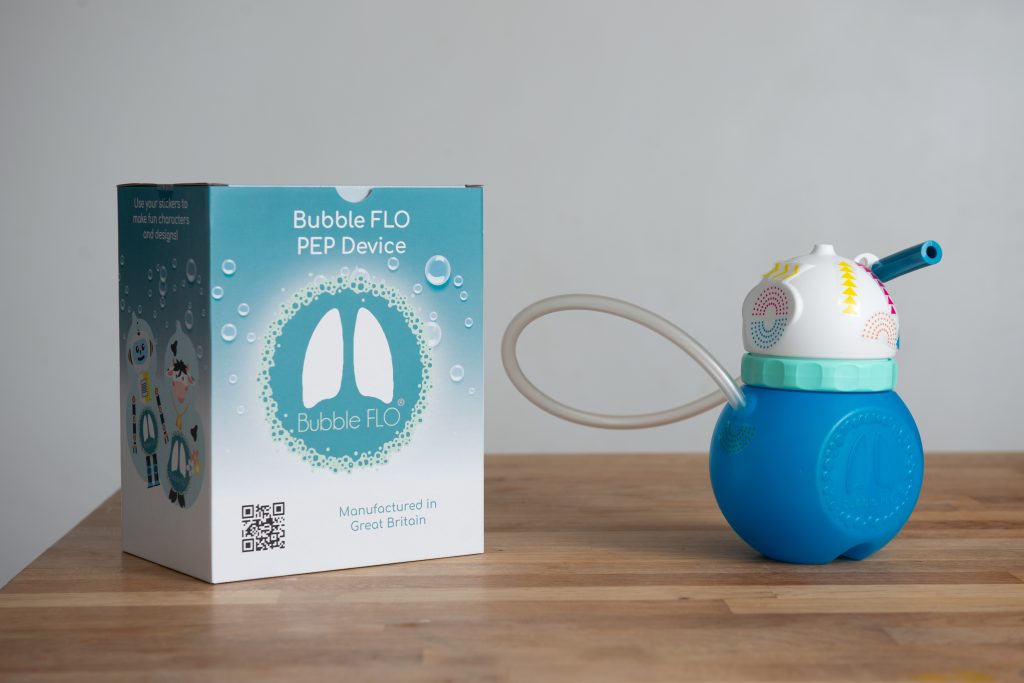
Bubble FLO® has created a fun, child friendly, visually engaging, and effective physiotherapy medical device the Bubble FLO® PEP (Positive Expiratory Pressure) Device for the treatment of chronic lung conditions.
Background
Bubble FLO® was set up by Katie Vance to develop a child friendly, engaging and effective physiotherapy medical device- a Bubble Positive Expiratory Pressure (PEP) Device for the treatment of chronic lung conditions.
Positive-expiratory-pressure (PEP) therapy is a respiratory therapy that applies resistance to expiration, to produce positive airway pressure. Since the 1930s, PEP has been used to improve oxygenation, increase lung volume and reduce venous return in patients with congestive heart failure. PEP improves collateral ventilation, secretion clearance, aerosol distribution and functional residual capacity. (Respiratory Care:April 2009, Vol 54, No.4)
Challenge
The idea of creating a Bubble PEP device evolved when Katie’s daughter was diagnosed with a lifelong respiratory condition and the equipment supplied to carry out vital twice daily physiotherapy was very basic and lacked visual engagement for children. Katie discovered there was no specific Paediatric equipment available, so she decided to develop a Bubble PEP Device which was fun, engaging and effective in clearing secretions from the lungs, and that was aesthetically pleasing, easily portable and easy to empty and re-fill.
The technology did not exist to meet these key practical needs and Katie recognised that such a product could be revolutionary in this critical field. The prototype that she developed was given very positive feedback from physiotherapists who worked with Katie’s daughter, and they expressed a need for a similar device for use by other patients and so Bubble FLO® was born.
Solution
To develop the concept Katie contacted Interface, who, after putting out a search to Scotland’s universities and research institutes, partnered her with Kath Sharp, NHS Team Lead in Paediatric physiotherapy at Glasgow Caledonian University, (who introduced the technique to the West of Scotland and acted as a consultant on the project), and Professor Terence Gourlay, from the University of Strathclyde’s Biomedical Engineering Department, who has extensive experience in the design, development and commercialisation of medical devices.
This collaborative project, funded by a Scottish Funding Council Innovation Voucher, focused on the development of a novel respiratory improvement technology aimed at the paediatric sector, but based on known and well-established approaches. The novelty in the proposed approach is centred around making what can be a tiresome therapy for children, fun and engaging.
The experience the Department of Biomedical Engineering has in the production of laboratory, test-ready prototype devices was applied to the project to produce near clinically deliverable prototypes of the proposed technology which were then successfully tested under laboratory conditions.
Subsequently Bubble FLO® was awarded a By Design Grant from Scottish Enterprise, which allowed the prototype design and ergonomics to be developed further.
Through the support of South of Scotland Enterprise, Bubble FLO® worked with an engineer to develop manufacturing tools, create 40 prototypes and completed bio burden and chemical compatibility testing.
Regulatory work has been completed with the support of CPI and Innovate UK to ensure the product is suitable for use.
BubbleFLO are hoping to start clinical trials with the West of Scotland Innovation Hub at the Royal Hospital for Children in Glasgow soon.
Interface have continued to assist Bubble FLO® brokering collaborations with the University of Strathclyde to create a brand and marketing strategy to target families of children with respiratory conditions and with Edinburgh Napier University to develop a “How to Set Up and Use” animated video with the aim of using animated characters to turn what can be a very daunting experience for a child into a fun and engaging one.
Benefits
As the Bubble FLO® PEP Device will be more engaging for children than the current NHS equipment; children will be much more motivated to carry out effective physiotherapy sessions and, in turn, this has the potential to save the NHS budget considerably through a reduction in hospital admissions for respiratory treatment.
Whilst initially, sales of the Bubble FLO® PEP Device will be to parents online, it is hoped the NHS will purchase this new medical equipment as a long-term investment to reduce their overall budget after completion of an upcoming clinical trial with the West of Scotland Innovation Hub, Royal Hospital for Children in Glasgow.
The development of the proposed technology will underpin the foundation of the commercial activity around this novel product. The company have benefitted from the University’s expertise in the development of prototypes, their laboratory evaluation and expertise in tooling design and production of the medical devices.
Subsequent collaborations have provided Bubble FLO® with a marketing and targeting strategy and produced a novel animated guide for children and parents to be able to use the device at home.
The academic partner has benefitted through this new research activity in the paediatric respiratory sector and in the use of this project as a case study for teaching purposes. In addition, the project fits very well with the Department’s objective of being supportive of the Scottish life science and med tech sectors.
This project was nominated for Innovator of the Year at the Scottish Knowledge Exchange Awards and won a Wild Card at the Scottish EDGE.
The Get Set Yeti app is in development, themed around a clan of yeti characters, that allows younger children to understand their emotions, through discovering ‘emotion beasties’, enabling difficult concepts to be put across in an age accessible and engaging way.
Background
Get Set Yeti is a Digital Education business, that specialises in using storytelling and character-based learning to make Growth Mindset accessible to younger children at school and at home. They aim to level the ‘educational playing field’ by helping children from all walks of life develop the skills to become confident, resilient learners. They also provide materials for parents to build their confidence and capacity to do the things at home that have an impact on creating solid school foundations in Early Literacy and Early Numeracy.
Get Set Yeti supports educators and parents to help children develop learning resilience and confidence through building a growth mindset, and through emotional literacy. They offer a range of programmes and resources themed around a clan of yeti characters.
The company came into existence through recognition of a need in the field and has been developed by its founder Carol Arnott. An experienced practitioner both in Primary and Community Education, Carol employed Growth Mindset techniques initially to develop a rhyming story to help local families struggling with learning confidence. The story of “The Yeti’s Roar” was born, developed into a book which grew into a learning programme that was successfully trialled in several local schools and nurseries in the Dundee area.
Developing the programme became a passion of Carol’s and with the help of Business Gateway and the Elevator Business Accelerator, where Carol was introduced to Interface, her business began and demand quickly developed to the stage of looking to grow the team and expand into other cities – then Covid hit. Unable to get into schools due to closures and distancing regulations and with other contracts put on hold it became apparent that digital learning was the way forward. A new site was built and ‘Get Set Yeti’ evolved and grew.
The Challenge
Get Set Yeti was created to provide Growth Mindset resources for children under 8 due to the lack of material available. In the educational climate, there was a growing need for children to learn to be more resilient in learning and it was widely recognised that learning to develop a ‘Growth Mindset’ could successfully meet this need.
Get Set Yeti was interested in developing an app or platform that could help young children understand and process emotions using Growth Mindset to help maintain positive mental health.
The Solution
Through the Accelerator in Dundee, Carol met Lorna Watson of Interface who identified University of Dundee’s Dr Michael Crabb (School of Science and Engineering) and Dr Alexia Barrable (School of Education and Social Work) who had the required academic expertise to develop an app that could help younger children develop emotional literacy and self-regulation. This initial project was taken forward with a £5000 Standard Innovation Voucher.
The team at the University of Dundee helped initialise ‘The Yeti Field Guide to Feelings’ app to help children develop emotional literacy, supported by parents and educators.
Based on the premise that deep in the forest on top of Yeti Mountain the yetis sometimes come across ‘Emotion Beasties’ that have escaped from children in the villages below. Once caught, the yetis learn how to look after them using their special book ‘The Yeti Field Guide to Feelings’. They learn that caring for feelings takes practise and learn techniques to manage them through online interaction and additional printable activities and resources.
The app will incorporate:
- Simple gameplay to capture the engagement of the user.
- Diagnostic tool Information on emotions.
- A range of resources and tools to reinforce and support, designed by appropriate mental health experts.
This innovation sits right at the heart of Get Set Yeti’s core strategy as it uses process design to help children and families understand difficult concepts and gives them the tools to develop skills to learn successfully using Growth Mindset techniques.
The Benefits
- Get Set Yeti created a collaborative co-design programme for children and are in the process of securing funding to create the app with all the necessary building blocks in place.
- Get Set Yeti have developed an ongoing partnership with the University of Dundee and are able to provide opportunities for current students and graduates.
- Further opportunities to connect to the School of Education, CLD and Social Work during the testing phase of the app, along with the Department of Science and Engineering.
The Next Steps
Get Set Yeti have transitioned through the restrictions brought about by Covid19, transforming from a localised, face-to-face delivery company to an online-learning portal with international potential.
Following on from this initial project the relationship between Interface and Get Set Yeti has continued to grow and there have been several more successful student projects/placements for a range of things from marketing to behavioural analysis as follows:
Due the restrictions brought about through Covid19 Get Set Yeti pivoted to produce a digital version of their material and with the help of Abertay University the company developed a digital marketing strategy to promote their digital offering and transform from a localised business to offer their products nationally and develop a marketing campaign to appeal to local authorities, head teachers, infant teachers and parents.
A successful student placement project with the University of West of Scotland helped Get Set Yeti achieve a targeted marketing campaign appealing to potential clients and partners; utilising social media and other appropriate available channels.
The University of Stirling undertook some behavioural analysis to help Get Set Yeti understand and develop customer personas to allow them to enter new markets and target their future campaigns for maximum impact.
University of Highlands and Islands students are currently working directly with the Musical Director and CEO to help devise a digital marketing and social media campaign to promote an album of original ‘Yeti Songs’ to enhance the delivery of Growth Mindset learning to younger children and their families.
Evolve™ green energy technology is the first hydrogen electrolysis solution that can extract hydrogen from any natural water source including groundwater, tap water, and seawater, without desalination.
Background
Evolve Hydrogen Ltd wants to develop novel Proton Exchange Membrane (PEM) electrolyser technology to produce “green” hydrogen for use in industrial processes. This innovation unlike the traditional flat-stack designs of common PEM and alkaline electrolysers is designed in a honeycomb configuration with reactive parts placed in a concentric layout. The reactive parts are fabricated via injection moulding of a custom polymer which allow this technology to utilise impure water sources.
The Challenge
In developing their technology Evolve Hydrogen Ltd required a bespoke polymer material that enabled direct electrolysis of impure water sources, for example, seawater without the need for desalination. Optimisation of this material required a thorough understanding of its electrochemical performance and transport mechanism in various electrolysis environments. To improve the efficiencies of their prototypes this project required electrochemical engineering expertise to give a full characterisation of the polymer raw material and to recommend improvements in composition to advance Evolve™ technology.
The Solution
Evolve Hydrogen Ltd sought the expertise of the University of Strathclyde to perform this project based on recommendations by their technical advisors, two of whom were alumni of Strathclyde University. Funding provided by Interface’s Inward Investment Catalyst Fund permitted the material characterization of the original polymer and suggestions for efficiency improvements to be carried out by the University of Strathclyde.
Evolve Hydrogen Ltd provided samples and previous technical data to the University’s research staff, who performed the physical and electrochemical characterisation required as part of Evolve’s aim to achieve TRL 4 (Technology Readiness Level) status. Dr Edward Brightman and his team of electrochemical engineers used their expertise to create a specialised test cell. They also demonstrated the knowledge and the flexibility to adjust the research scope to address new questions of the materials being analysed.
The work performed by the team of electrochemical engineers successfully characterised the original polymer material and suggested material and dimensional changes to improve the efficiencies of Evolve Hydrogen’s technology.
The Future
Evolve Hydrogen Ltd is committed to working with the University of Strathclyde because of their demonstrated level of professionalism, knowledge, creative thought, and the working relationship that has been established. The University, the Power Networks Demonstration Centre (PNDC), and their industrial partners plan to collaborate for the testing of future prototypes and the fabrication of Minimal Viable Products for Evolve Hydrogen’s demonstrations. They are seeking joint funding together to support an R&D pathway towards commercialisation in Scotland.
The Benefits
- The benefit of this project is to further the development of a novel green hydrogen production technology and to commercialise the technology in Scotland.
- Decarbonization of transportation and many industrial processes with the integration of Evolve’s technology throughout Scotland.
- Development of future strategic partnerships with key industry players in manufacturing, polymer production, and hydrogen end users such as offshore wind farms, utilities, and the transportation sector.
- With the global demand for electrolysers far exceeding the supply Evolve see a tremendous growth in exports of their technology for Scotland starting in 2024.
This project benefitted from the Scottish Inward Investment Catalyst Fund. The Scottish Inward Investment Catalyst Fund launched by Interface and the Scottish Government promotes Scotland as a leading destination for inward investment and supports businesses not yet located in Scotland but seeking to establish stronger ties with academia here. As well as funding research and development it provides an opportunity for the company to establish relationships and give insight into other aspects of the Scottish landscape, such as further investment opportunities, supply chains and the skills base to strengthen the case for investing in Scotland.
Learn more about the Scottish Inward Investment Fund.
Background
Entergaia Technologies located in Aberdeen, Scotland is a holding company for value creating entities in the areas of energy technology and AI and Analytical software development. Entergaia Technologies aims to push the boundaries of innovation and technology.
Formed in 2018, Entergaia Technologies were looking to develop a long-range wireless power transfer (WPT) solution that would result in the creation of a new portfolio focusing on long range wireless power transfer.
Wireless power transfer (WPT), wireless power transmission, wireless energy transmission (WET), or electromagnetic power transfer is the transmission of electrical energy without wires as a physical link. The technology of wireless power transmission can eliminate the use of the wires and batteries, thus increasing the mobility, convenience, and safety of an electronic device for all users. Wireless power transfer is useful to power electrical devices where interconnecting wires are inconvenient, hazardous, or are not possible.
The Challenge
The manufacturing process of electrical wire, steel and batteries emit enormous greenhouse gases into the atmosphere. Entergaia Technologies wanted to develop a Wireless Power Transfer System (WPT) that demonstrated the long-range transmission of electrical power which could gradually reduce the use of steel wires and reduce the number of batteries used in storing electricity, which would in turn, reduce greenhouse emission and improve environmental sustainability. There was evidence to suggest that Entergaia’s WPT model worked but only over short distances.
Entergaia Technologies required assistance from an academic institution to investigate potentially three projects. Initially a proof of concept to look at the notion of beaming electricity from the point of production to the point of utilisation without electrical cables or batteries, followed by testing of such a model and then the development of a demonstrator.
The Solution
Entergaia Technologies with assistance from Dr Peng Li of the University of Aberdeen aimed to develop a Wireless Power Transfer System (WPT) that demonstrated the long-range transmission of electrical power. The solution would gradually reduce the use of steel wires and reduce the number of batteries used in storing electricity, which would in turn, reduce the amount of greenhouse gases emitted into the atmosphere through the production of steel cables and batteries.
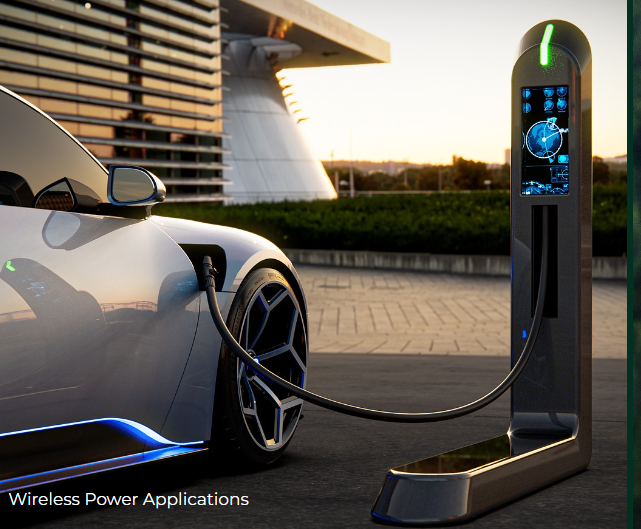
During the initial phase, the application focussed on the possibility of a long-range wireless-powered electric vehicle charging system that was beyond any current near field deployments in existence. Subsequently simulations showed that long range transfer of electrical power is possible.
The work also established the possibility of electromagnetic beam tracking and directioning – which means tracking the transmitted electrical energy in motion. The beam technology would help in future developments of a wireless power charging solution that is mobile and semi-autonomous, enabling charging of electric vehicles in motion or beaming electrical energy from space, where there are no energy losses due to positional changes.
This phase also identified areas of the components analysed that require significant improvement and showed the possibility to combine some technologies to help future prototyping and product development. The understanding derived from this work would be beneficial for Entergaia’s future strategy in deploying associated products such as beaming electricity from space, wireless electricity deployment during emergencies, beaming wireless electricity to charge robots, IOT devices and remote vehicles (ROVs).
The Future
The result from the initial collaboration with the University of Aberdeen showed that although it was possible to develop a Wireless Power Transfer System (WPT) that demonstrated the long-range transmission of electrical power there was the need to increase power efficiency received at the receiving end that would eventually charge the battery. Entergaia Technologies’ focus then turned to optimising the receiving end that charges the battery – a rectenna, to enable effective conversion of the microwave radiation received, to electrical energy, and loading the charge effectively onto the battery or other alternative storage.
Entergaia Technologies secured an Advanced Innovation Voucher through Interface and partnered with Edinburgh Napier University who are producing an optimised prototype that improves power efficiency.

The Benefits
- Initial proof of concept established that it was possible to develop a Wireless Power Transfer System (WPT) that demonstrated the long-range transmission of electrical power. Leading to a reduction in the use of steel wires and the number of batteries used in storing electricity, which would in turn, reduce the amount of greenhouse gases emitted into the atmosphere through the production of steel cables and batteries.
- The initial collaboration helped Entergaia embark on further product development work with Edinburgh Napier University focussing on optimising both the transmitter and the rectenna (receiver end) to enable effective conversion of the microwave radiation received, to electrical energy, and loading the charge effectively onto the battery or other alternative storage.
- The findings are helping inform Entergaia’s future strategy in deploying associated products such as wireless electric vehicle charging, beaming electricity from space, wireless electricity deployment during emergencies, beaming wireless electricity to charge robots, IOT devices and remote vehicles (ROVs).
Leanne Cairns Millinery designing and producing Occasion Wear Bio Hats, which are 3D printed, environmentally friendly, Low Carbon, Zero Waste and Industrially Bio-degradeable.
Background
Leanne Cairns, a milliner, based in rural Ayrshire has been designing and creating hats, fascinators and wedding head dresses for her clients from her studio for several years. She is dedicated to creating bespoke luxury and elegant millinery for special occasions.
The Challenge
Leanne saw potential in the largely untapped Scottish market within the wedding and up market, occasion wear, events sector for individually crafted, bespoke hats that could be created in exactly the right colour for matching outfits, as well as being made from locally sourced environmentally circular materials that offered very individual, ethically sourced and quickly manufactured hats.
Leanne from an early age enjoyed sewing, making, drawing and painting. She originally studied an Interior Design BSC and then through various design related employment, Leanne developed a love of 3D design Auto CAD, spacial and technical design, ingenuity of structural design and pattern making.
Leanne has always been of the mindset of ‘Make Do and Mend’ having always been someone that never throws away anything if it can be re-used in a creative way. An avid recycler from childhood this was always the background driver in her traditional craft of millinery and so a mission to be more sustainable in the design and production was a natural progression.
Leanne Cairns Millinery’s clients were mainly in the 35+ age bracket however Leanne identified a potential market segment in the 18-35 age bracket that didn’t understand or know about the social and confidence building benefits of wearing hats. Market research of this potential target market was undertaken by students in Fashion Marketing at Glasgow Caledonian University supported by Interface. The research clarified that the 18- 35 age segment were very eco-conscious and wanted to make a difference to the planet by not buying fashion that would contribute to landfill accumulation.
The findings of this research lead onto a further collaboration with the team at Napier University to discover a circular, zero waste product that would lead onto a commitment to providing innovative new hat design and manufacturing utilising 3d printing with industrially bio-degradeable materials that are locally and ethically sourced, with a low carbon footprint.
The Solution
Leanne was originally referred to Interface by West Coast Accelerator. Mari of Interface was able to identify Edinburgh Napier University as a partner and academic Dr Samantha Vettese who had the interest and experience required for Leanne’s project. A Scottish Funding Council Innovation Voucher was secured.
Leanne worked with Dr Samantha Vettese and Dr Xingyu Chloe Tao, on 3D product designing, 3D prototyping and general development of 3D recycled millinery which included:
- Computer Aided Design
- Design Modelling on 3D software
- Product Development
- Creative Input
- Manufacturing Prototype /design
The Benefits
Leanne very much believes in designing and producing products, which can be 3D printed, are environmentally friendly with recycling and re-using the wearable hats at the end of their life cycle. A take back scheme of the manufactured designs would be a differentiator and make a difference to the planet and the surrounding environment by re-using the product in the biodegration process to create energy and other products, thus prolonging a circular end of life.
Some of the main benefits of the collaboration are:
- Successful development of prototypes for market testing helping showcase the possibilities of 3D printing in occasion wear hats.
- The capability to produce environmentally friendly, recycled, wearable hat art to be sold via e-commerce, designed using STEM (Science, Technology, Engineering and Mathematics) and digital products to be sold to 3D printing enthusiasts with no wastage and low carbon footprint.
- Potential to push the boundaries of this traditional based industry in a more STEM and modern approach to climate change.
- Ability to make more sculptural and futuristic head pieces designed by Leanne Cairns Millinery and sell utilising online, e-commerce and bespoke commissions within the fashion houses or private clients.
- Ability to rapidly prototype and manufacture efficiently with digital adoption.
- Opening up new markets for Leanne Cairns Millinery in the online sector with branding via tourism, metaverse, blockchain and e-commerce.
- Leanne Cairns Millinery becoming a South Ayrshire Carbon Champion with the prototype and organisation carbon auditing achieved with low results and a commitment to Net Zero by 2050 via the SME Climate Hub
- Continuation of R&D via Student Innovation Voucher with a brilliant relationship now established with Napier University.