
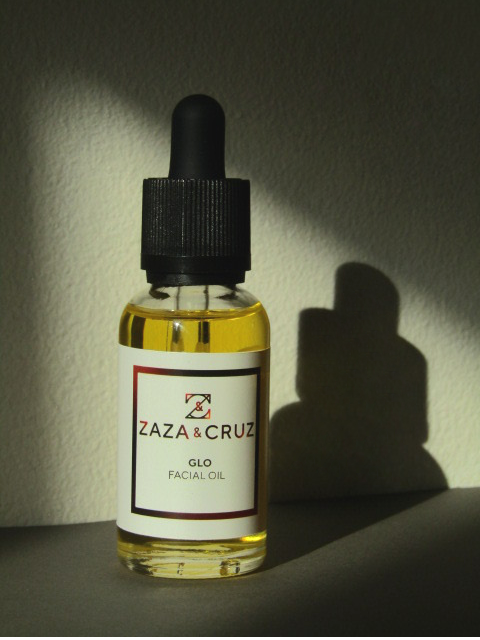
ZAZA & CRUZ to create a unique natural skincare blend using by-products of the whisky distillation process to rejuvenate and moisturize the skin whilst also shielding against cellular damage and anti-aging.
Background
ZAZA & CRUZ is a natural skin care company that aims to provide high-quality natural ingredients at a reasonable price. Its mission is to make its customers feel confident in their skin.
Rebecca Hastings, a makeup artist, and beauty specialist founded the company in 2013. Her children inspired the company’s name. As a make-up artist, she became increasingly concerned about what was in the products applied to the skin of her clients and her children. Consequently, she researched the most beneficial natural oils and botanicals in 2011 and created her unique natural blend of ingredients that rejuvenated and moisturized the skin while also shielding against cellular damage and anti-aging.
The Challenge
Kirsty of Interface met Rebecca at a HIE event in 2019, where they discussed the innovation potential of her business. They chatted about the beneficial effects on aging of the skin that the sake yeast fermentation process was proven to have by a Japanese company SK 11 in the 1970’s. The resulting complex that was created is now used throughout the whole Japanese skincare range. This led on to a conversation about the potential of whisky in skincare.
ZAZA & CRUZ were looking to use natural ingredients and processes to develop an active antioxidant/enzyme extract from whisky which would help with skin rejuvenation and could be used in their luxury skincare range.
Rebecca, founder of ZAZA & CRUZ was seeking to find out if the antioxidants and enzymes produced during the whisky distilling process could prove beneficial for skin rejuvenation in collagen and cell turnover, and if they could be extracted to become a natural ingredient in her skincare products.
The use of the findings will enable ZAZA & CRUZ to infuse a brand of whisky into their luxury skincare line. This in turn will benefit the partner of the whisky brand to tap into a wider cosmetics market.
The Solution
Robert Gordon University came forward to support Rebecca’s ideas, and Kirsty stayed on hand to support Rebecca with discussions. Rebecca felt that the expertise and enthusiasm from the team at RGU were the right fit for her and so moved forward with an Innovation Voucher
The project focussed on extraction, analysis and testing to discover and prove that the active and complex mix of antioxidants, enzymes and plant phenols released from whisky during the distillation and fermentation process could be extracted and provide a natural and safe solution for the skin which could then be used in the whole luxury line of skincare products for the consumer.
Firstly, the project looked at the antioxidant capacity of pot ale and effluent samples from whisky distillation using different assays as well as evaluating their toxicity at a cellular level. This was then applied into the formulation of the skincare products. Finally, an assessment of their antioxidant activity, that is, their protective effects on skin, was investigated. It was found that placing the nutrients from whisky in skincare can help to boost the skin and help fight free radical damage from the environment. In addition, polyphenols from whisky have the added benefit of helping to reduce inflammation, puffiness, and calms redness in the skin; making is a great ingredient to use in a moisturiser every day.
The findings from this collaboration will enable ZAZA & CRUZ to infuse a brand of whisky products into their luxury skincare line that can benefit consumers’ skin.
The Benefits
The benefits to ZAZA & CRUZ:
- Being able to work with a highly specialized and qualified team at RGU with great knowledge of the extraction process for antioxidants.
- A better understanding about the process of extraction and how to adopt a more scientific approach towards testing and incorporating ingredients into skincare products.
- Quality results that can be used to push the project forward and be innovative in the skincare industry.
Rabbie Burns goes virtual – Robert Burns Ellisland Farm recreated in Minecraft highlighting the life and great works of the National Bard.
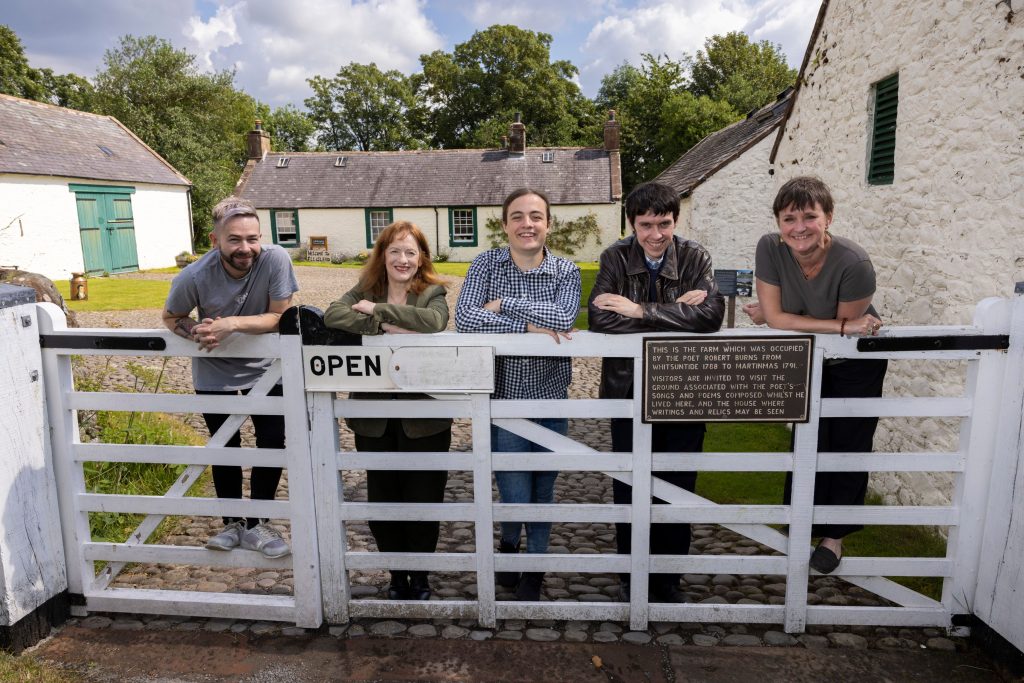
Ellisland Museum & Farm was the farmhouse built by Robert Burns, Scotland’s National Bard in 1788. It was his home, where he farmed, and where he worked as an Excise officer. Today Ellisland is a much-celebrated museum housing one of the world’s most important collections of Burns treasures.
Background
Ellisland Museum & Farm near Dumfries was the farmhouse built by Robert Burns and was his home until 1791 where he farmed and worked as an Excise officer. During his time living there he experienced his most creative and fruitful years in terms of his poetry and song. This is where he wrote Tam O’Shanter and Auld Lang Syne. Today Ellisland is a much-celebrated museum housing one of the world’s most important collections of Burns treasures.
The Challenge
During 2020/21 Covid-19 saw visitor numbers drop dramatically and visitor attractions closing their doors for a significantly long period, some of them indefinitely. The main challenge during this time was how to maintain interest, widen reach and encourage visitors to return.
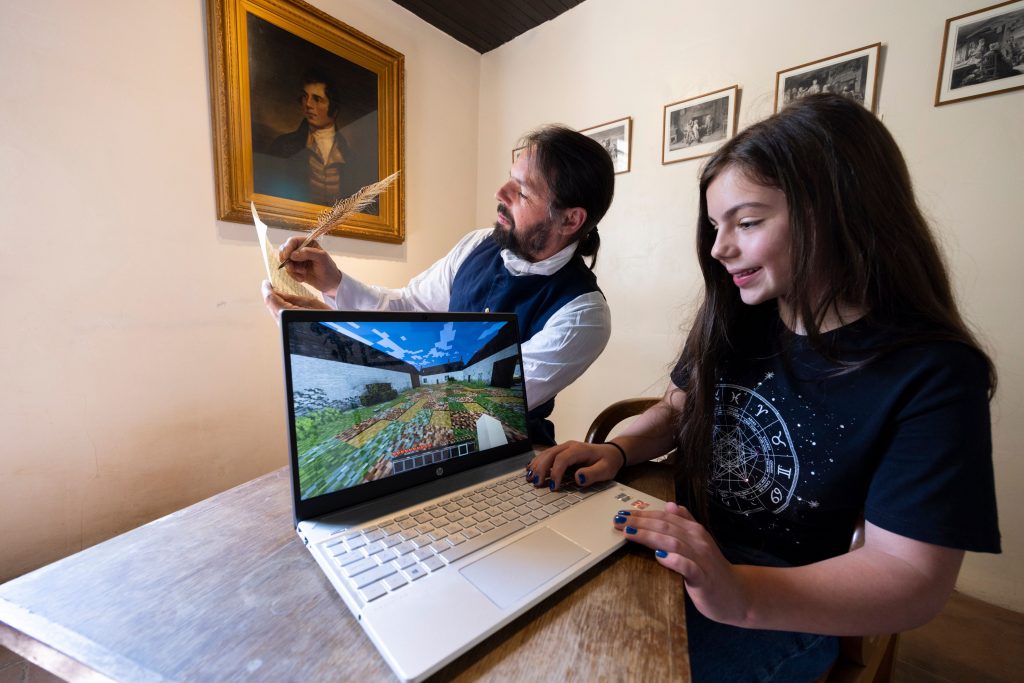
The Ellisland Trust, who run the Ellisland Museum & Farm wanted to develop an interactive Robert Burns Minecraft digital experience appealing to a younger audience to highlight the life and great works of the National Bard. Their idea was to depict his life as an Excise Officer and farmer as well as highlighting his poems and songs and other Burns associated landmarks in Dumfries and Ayrshire.
The Solution
Ellisland Farm, where Burns lived from 1788-1791, has been brought back to virtual life in Minecraft.
Students and academics at the University of Glasgow worked with the Robert Burns Ellisland Trust to faithfully recreate, in Minecraft, the 18th-century farm as Burns and his family knew it.
The Minecraft Ellisland world was built by around 15 students – undergraduates and postgraduates drawn from a range of different subjects – who are part of the University’s Minecraft Society.
Bailey Hodgson, the Minecraft Society’s President and one of its founders, who has been using Minecraft for 12 years, played a significant role both in project setup and delivery.
The Minecraft Ellisland project was led by Dr Timothy Peacock and Dr Matthew Barr from the University’s Game and Gaming Lab, a cross-disciplinary lab – based in the University’s College of Arts – with a focus on how games and gaming can be used in research and teaching.
Interface were able to find an academic partner at very short notice to tie in with funding from South of Scotland Destination Alliance (SSDA) and made the relevant introductions between the University of Glasgow, SSDA and Ellisland Trust.
The project was funded through SSDA from the Scottish Government’s Tourism Leadership & Recovery Fund which supports tourism enterprises taking the lead in the sector’s COVID-19 recovery.
The Benefits
- The Robert Burns Minecraft experience is an innovative use of gaming technology to reach a wider, younger audience. Engaging young people with Robert Burns in a modern, appealing way will help to raise the profile of his work and lead to an increase in visitors to the Ellisland Farm and other associated Robert Burns visitor attractions in and around Dumfries and Ayrshire.
- Players have an opportunity to not only hear Burns’ poetry and song while in the Minecraft world but are also able to converse in Scots with the poet and his wife Jean Armour. It is believed to be the first time Scots has been spoken on Minecraft, which has nearly 140 million monthly active users around the world.
- The Burns Minecraft experience has widened the reach and appeal of Robert Burns, his life and works, attracted a younger demographic and helped the Ellisland Museum and Farm thrive and survive post Covid-19.
Unlocking Potential (U>P) – a powerful people analytics platform helping organisations of all sizes to optimise their workforce
Background
Nectis Ltd focuses on optimising wellbeing, performance and productivity in the workplace through people analytics and understanding business ecosystems. Founder and CEO, Colin Campbell has a wealth of experience in this area, having spent more than 20 years building company ecosystems (the people related to your company).
The Challenge
Nectis Ltd successfully competed to deliver against CivTech 5, in 2021 with sponsor Transport Scotland. Their Challenge – How can tech help foster the development of informal networks when people are working at home or in Work Local hubs?
To assist in addressing the challenge and through the partnership between CivTech and Interface, Colin approached us to help facilitate collaboration with academia on three 3 different projects:
- Data Visualisation
- Business analysis of Serviceable Available Markets
- Security and Anonymised Data Cloud Analysis
The Solution
The solution developed by Nectis Ltd is Unlocking Potential (U>P) Unlocking Potential – Optimising Business Agility & Performance, a SaaS people analytics platform that visualises patterns of collaboration and uses insight to create agility and wellbeing. This solution uses data driven insights of individuals and teams, to understand their patterns, overcome barriers and breakdown work silos. In addition, it provides an evidence base for fair working practices, supporting positive working relationships.
People analytics is a very powerful tool and up until now, the science behind it has been the reserve of researchers and programmers.
Unlocking Potential (U>P) is a software tool that works by creating a digital model of a company ecosystem (the people related to any organisation) and then analysing it to deliver unique and powerful insights that can help achieve high levels of business agility and performance.
To assist in addressing the challenge set by Transport Scotland Interface helped facilitate collaboration with academia on three 3 different projects:
- Data Visualisation
- Serviceable Available Market
- Security and Anonymised Data Cloud Analysis
The first related to Data Visualisation where a Data Science for Business MSc student at the University of Stirling undertook a project working with data that was already on the U>P platform and also tested data, to find ways to increase the rate at which data is added, through motivational feedback loops. This was achieved by identifying which forms of data design and delivery optimised insight creation for individual users to help them solve problems and/or take meaningful action.
Beyond the initial contract with Transport Scotland, Nectis wanted to understand market potential and their initial B2B target market i.e. organisations with remote/complex workforces. Masters marketing students at the University of Glasgow carried out research to establish the serviceable available market for their offering and establish what Nectis could legitimately claim they could deliver on and how to articulate it to these customers. Other student projects looked at innovation within Nectis’ pricing strategy and at finding ways to reward people for adding data that builds the aggregate picture, as well as, providing value for them individually.
The third project relating to Security and Anonymised Data Cloud Analysis was as a result of a successful Advanced Innovation Voucher application and involved the School of Computing at Edinburgh Napier University. This collaboration built on work already done by U>P with the aim of improving the levels of security in the application, focusing on the collection and processing of personal data, as well as, introducing advanced security measures to enable intelligent analysis of anonymised data.
A key aspect of the work involved the use Big Data analysis methods in understanding the complex relationships involved in projects, roles, business relationships, behaviours, and so on, to determine good practice in achieving strong outputs, and thus more clearly identify how best to both understand the metrics to be gathered, but also in how to best define KPI (Key Performance Indicators). Understanding that the collection of data around business relationships requires to be kept private, Nectis wanted to develop privacy enhancing methods, which could be used to assess successful engagement, but respect privacy and consent. The collaboration with the School of Computing at Edinburgh Napier University with their strong background in cryptography, and other privacy related areas, along with their experience in building production ready systems was crucial to the success of this project.
The Benefits
The academic rigour awarded by the collaborations with academia have been good for the Nectis U>P brand and have resulted in Nectis achieving the following:
- An SE SMART grant of £92K to continue the collaboration with Edinburgh Napier University as a result of the AIV scheme. Total investment £160K
- Accepted onto the UK Cyber Accelerator – one of only 3 Scottish companies to do so
- Proof of concept for Scotland IS Cyber
- Proof of concept for Scottish Government
- Plan to raise £500K investment in forthcoming year
- New patent application – Patent is for a distributed key system so individuals have a say in how their data is managed
The Crover – the world’s first robotic device that ‘swims’ through grains to monitor their condition.
Background
Crover Ltd https://www.crover.tech has developed the world’s first small robotic device, known as a ‘CROVER’, that monitors cereal grains stored in bulk inside grain bins or storage sheds. The CROVER device can “swim” within the grains and uses on-board sensors to measure local parameters, such as temperature and moisture, to build a full map of the conditions within the grains. Unlike current grain monitoring solutions that measure only one variable and have limited reach, the CROVER’s remote monitoring capabilities provide real-time data across a range of measurements allowing grain storekeepers to identify critical conditions, like hotspots early and maintain quality of the grains through proactive management.
Crover Ltd were a start-up when they initially approached Interface in 2019, they have since grown from two co-founders to 20 employees.
Since 2019 they have secured significant investment, raising over £600k in innovation prizes and grants (including Scottish Enterprise and Innovate UK). They then opened a seed funding round for investors and hit their £150k target.
The Challenges / Solutions
“When we initially met Interface, we didn’t have a specific R&D challenge as we were focused on developing our product inhouse. An obvious area for support would have been in the areas of design and engineering, however, through discussions with Louise, she assessed how our business worked and proposed that we undertake a project with the Scottish Financial Risk Academy (SFRA). The project with the SFRA helped us determine precise financial estimates of the value of Crover data to grain storekeepers and its impact on the grain storage economics. Understanding the financial impacts of Crover’s monitoring capabilities, had wider implications such as being able to quantify monetary value to grain insurers, and the potential to reduce insurance premiums for farmers and grain merchants.” Lorenzo Conti, Co-founder Crover Ltd
Following on from this initial project, one of the main technical challenges Crover Ltd faced related to the precise location tracking of the device within the grain bulk. Conventional signals, such as GPS and WiFi, did not work due to their inability to penetrate the solid grain bulk so a novel approach was required. Crover Ltd had undertaken some initial testing of different solutions, however they needed to tap into academic expertise in ultrasonic waves, positioning systems, electromagnetic signals, wireless sensor network (WSN) and Simultaneous Localization and Mapping (SLAM), to help improve the accuracy of the device location. Interface connected them to the University of Glasgow who undertook an initial feasibility into a means of measuring and identifying the location of the robotic device in bulk grain storage. This was initially funded by an Impact Accelerator Account fund of £10k, which then led onto a further project where University of Glasgow and Crover Ltd secured a further £27K to continue the project to a successful conclusion.
Since the initial collaboration Interface has assisted Crover Ltd embark on several other successful collaborations focusing more on the future enhancement and performance improvement of the robotic device, by tapping into design and engineering expertise from several Scottish Academic Institutions. These involved:
- Heriot-Watt University (HWU) design engineering students looking at designs for a remote charging station for the Crover to allow re-charging when out on location.
- HWU design engineering students helping to develop an easily deployable, suspended cable system that provides cable above the Crover to facilitate its movement within grain sheds.
- University of Strathclyde’s design engineering students designing a water-tight sealing system for the Crover.
- University of Strathclyde’s Department of Design, Manufacturing and Engineering Management (DMEM), investigating suitability of design for manufacture.
The Benefits
The benefits resulting from the numerous collaborations which Interface have helped broker have undoubtedly helped Crover Ltd in both product development and business growth terms. Interface has helped open doors for Crover Ltd and helped Lorenzo and his team to establish strong links with academia resulting in some innovative and exciting developments.
Since its inception in 2019 Crover Ltd has grown from 2 employees to over 20 employees, has raised significant investment and secured over £600K in innovation prizes and funding.
Background
Touchless Innovation, trading as Sanodaf, is a company that specialises in advanced disinfection and decontamination technology. Their aim is to create, design and manufacture innovative processes and products to help eradicate micro-organisms and infections that can cause health issues in everyday life for people and animals. They have experience of disinfection and decontamination as a service company and were looking at new devices to enhance current hygiene technology.
With expertise in environmental decontamination, Touchless Innovation developed a novel prototype of an easy-to-understand and cost-effective hand-hygiene device. It was based on the simple principle of using ultraviolet to kill micro-organisms that are commonly found on hands, specifically using UV-C which is proven technology for eradicating pathogens. The prototype was a hand sanitiser unit that prompted the user to place their hands inside an aperture that delivered a short transmission of UV-C directly onto hand surfaces. The unit was automated and, upon entry, a timed exposure to UV-C would be experienced by the skin. It was a touchless process and the unit would indicate when hands could be removed. The entire process was delivered quickly and without any noise or residue.
Specialist UV-C devices are used in laboratory settings but there was not an accessible device for everyday use. The creation of this device would allow people to efficiently sanitise hands without access to washing facilities and within a much-shortened time period.
Challenge
The company did not have the required expertise to test the device and demonstrate the intended claim that it kills 99.9% of MRSA after a short exposure on the hands and that it was also safe for human exposure. The practical work to test the device required a respected Category 2 laboratory facility and testing by an independent body for credibility.
Solution
Interface connected Stuart White, Director of Touchless Innovation, with Edinburgh Napier University as it had the laboratories, expertise and bacterial strains required to carry out the microbiological aspects of the work. This collaborative project was funded by a Scottish Funding Council Innovation Voucher.
Benefits
The results of the project allowed the company to identify any potential areas for design improvements and confidently market the device as a high volume, commercial product. Given the robustness and limited cost, it was considered that the portable version of this device would have an immediate market, both domestically and internationally.
The success of this product would improve the ability to sanitise hands in everyday situations to fight infections and ill health and would create jobs in Scotland where the device would be manufactured. The product had wide market appeal and the company’s intention was to expand globally into other markets where hygiene is poor and access to clean water restricted.
The company also planned to have a version of the device to be used in disaster situations where there was no power or clean water and a high risk of illness and infection spread.
It has been a privilege to work with the team at Napier; they have shown a high level of interest in the project from day one and demonstrated a very professional level of competency in undertaking the project, and in publishing the final result. This now leaves my company able to grow and expand with this product and I hope to be able to work with the team at Napier again. The result of this collaboration will make a very positive impact as we can now press ahead with the creation of working prototypes and move closer to releasing this product onto the market place. We are aiming to sell it in the UK and overseas and this will be a significant step for us as an SME (small or medium-sized enterprise). Stuart White, Director, Touchless Innovation
It was an excellent experience working with Touchless Innovation. The partner was extremely enthusiastic about their product but also realistic with the aims of this project. I look forward to working with them again. Dr Nick Wheelhouse, School of Applied Sciences, Edinburgh Napier University
Touchless Innovation Ltd was shortlisted for the Innovation of the Year award at The Scottish Knowledge Exchange Awards 2019.
Follow-On Activity – Advanced Innovation Voucher
Following on from their initial project with Edinburgh Napier University, Touchless Innovation were looking to collaborate with a university partner to verify that electrostatic spraying of hydrogen peroxide was a more efficient method of decontaminating hospital rooms than fogging, the current standard method used in the NHS. Interface was able to successfully connect them to the University of the West of Scotland (UWS) where the company had access to the University’s specialist category 11 containment facilities, including the facilities required to undertake testing of the fogging and electrostatic spray disinfection delivery systems. This project was funded by a Scottish Funding Council Advanced Innovation Voucher.
Benefits
The results of the project confirmed the company’s expectations as well as highlighting some additional considerations for future treatments and applications. A full submission of the results was made to the NHS and Health Improvement Scotland.
Follow-On Activity – KTP
The current approach to disinfection/decontamination utilises two separate units: a fogging system and an electrostatic sprayer; the former being used to transform the disinfectant liquid into a dry fog for areas that can be effectively sealed off, and the latter which adds a negative electrostatic charge to the solution ensuring it surrounds and adheres to all surfaces it touches (for open-area use where traditional fogging would not be appropriate).
As the company had no engineering capability, they formed a Knowledge Transfer Partnership (KTP) with UWS to develop a unique combined fogging and electrostatic spray disinfectant device for commercial use – two different technologies to run from one power source. This would underpin rapid business expansion and ensure the UK is at the forefront of market-led technology, addressing both societal and economic impacts of poor hygiene control within public and private buildings.
Benefits
Business – Prior to the KTP, the business was dependent on external suppliers/market forces, limiting the control of their own direction. The KTP has enabled the business to become a manufacturer of their own device, allowing them to compete in a wider market and decide their own path.
They have benefitted greatly from being involved in the process of designing and creating a new concept for a device and then being able to carry this through to product build and test. The process has helped the business understand manufacturing and the issues around supply chain, in-house and external expertise and how these are linked in the creation of a new product.
Finally, the investment has enabled the business to acquire the global Sanondaf brand, operating across multiple territories and with ready-made customers for their new combined electrostatic/fogging unit.
Academic – The project, based on an Advanced Innovation Voucher, allowed a strengthening of the relationship with a fast-growing business as well as providing an opportunity for cross-school collaboration between the School of Health and Life Sciences and the School of Computing, Engineering and Physical Sciences. In addition, the project provided an opportunity for:
- Demonstrating research impact for downstream REF reporting and publications
- Impact against UN Sustainable Development Growths in line with corporate strategy
- Further KTP portfolio growth for School and UWS in line with 2025 strategy
- Potential for further collaboration with the business.
Our experience of the KTP scheme, working with UWS, and the support on offer from Innovate UK has been exceptional and we are on the cusp of rapid business expansion as a result. I would thoroughly recommend the programme to any ambitious business that is looking to innovate and embed new knowledge within their organisation. Having seen the capabilities of the model, we are already framing a potential follow on KTP – Stuart White.
Touchless Innovation Ltd was shortlisted for the Innovation of the Year award at The Scottish Knowledge Exchange Awards 2022.
Background
Since 1999, Tweeddale Youth Action (TYA) has operated as a youth-led organisation that gives young people a safe space to congregate, an alternative to bus stops and street corners. They operate two youth clubs in Peebles and Innerleithen and through the provision of free opportunities for all, they support young people in accessing advice, developing skills, confidence, and a sense of belonging and responsibility within the community.
Challenge
Five years ago, TYA received LEADER (a European Union initiative to support rural development projects in rural, coastal and urban areas of EU member countries) funding that allowed them to invest in a metal workshop, a bike repair shop and a fully kitted out commercial kitchen. Off the back of this, TYA has grown several micro enterprises within the youth club – Bike Punks and Food Punks.
Bike Punks is based around their in-house metal workshop. They started repairing unwanted bikes and giving them back out to the community, teaching young people metalwork as well as bike repair skills.
Food Punks is based around their commercial kitchen and delivers outside catering for events, weddings etc. As well as the kitchen, they have a van and outside cookery equipment and teach young people the skills involved in outside catering.
Pre-Covid, both endeavours had healthy income-generating capacity. With Bike Punks, TYA had a service level agreement with local authorities to support young people in learning metalwork skills. In addition. they had an agreement with the South East of Scotland Transport Partnership to provide an e-bike library locally as well as an e-cargo bike delivery service. Similarly, Food Punks saw a steady demand for events catering.
This pipeline of business disappeared with the onset of Covid and TYA found themselves at a crossroad. Both Bike Punks and Food Punks had a strong brand to build upon and TYA had ideas they were interested in taking forward to diversify their offering.
Tweeddale Youth Action needed help with developing a business strategy to see where the opportunities lay and which of their ideas should be taken forward.
Solution
After being referred by South of Scotland Enterprise, Shelley Breckenridge, Business Engagement Executive at Interface, was able to connect Dave Hodson, Locality Manager at TYA, to Ed Green, Business Development Manager at the Adam Smith Business School, University of Glasgow, who was looking for consultancy projects for his students. The TYA project received the support of two separate groups of University of Glasgow students.
The project brief for the students was:
- A better understanding of local and national needs and opportunities that would help inform a linear approach; prioritising income-generating opportunities over others.
- A better understanding of TYA’s gaps and needs; informing their fundraising and recruitment strategy for the following five years.
- Sustainability of youth work delivery and opportunities through income generation.
Initially, as part of their consultancy projects, a group of full-time MBA Students at Glasgow University researched and prioritised these ideas, considering in-house resource to develop a strategy and a way forward. As a follow up, a group of undergraduate students on the ‘Entrepreneurial Ventures: Management & Growth’ course (which works primarily with social enterprises and charities) were given the same brief to deliver new viewpoints for the company.
Benefits
This process of consultation meant that the time commitment needed from TYA was reduced to a minimum whilst receiving insightful and helpful suggestions from the students. Equally helpful for the Locality Manager was being given the luxury of taking time out from the usual spinning of plates to think and reflect on where the organisation was and where they needed to get to. Creating the time to articulate the organisation’s needs, and having this reflected back in reports that they could share and act on, was invaluable to them.
Background
In his spare time, Mark Yeadon, founding Director of c-monsta, is an avid surfer. It was during his surfing trips that Mark became frustrated about the lack of way to allow his surf kit to dry, keep it all together and transport in a convenient manner. This led to the development of an early-stage prototype of a wetsuit dryer, a form of hanger, shaped so that boots and gloves could be hung in an inverted position, allowing them to dry; with a further row that could also hold a wetsuit.
It just so happened that the shape Mark had created looked very much like a sea-monster, and so c-monsta was born!
Throughout the development stage, Mark produced several working prototypes, so he knew the concept was viable and that it functioned effectively.
Challenge
Mark was looking to work in collaboration with a university partner to develop the product further by enhancing the design, minimising the use of materials, and identifying the best possible materials that could be used in the manufacturing process. Design expertise was needed to make the product fully market ready.
Solution
After being referred by Elgin Business Gateway, Carol-Ann Adams from Interface successfully partnered Mark with Nick Bell from the Product Design Engineering Department at Glasgow School of Art (GSA).
The project focused on optimising the design by taking advantage of the product design skills, detailed materials knowledge, and extensive network of manufacturers that GSA has, to develop a design that would have great functionality and could be manufactured at a price point that would make the product commercially viable.
The collaboration was an immediate success, using GSA’s skills and the client’s network of surfers to develop a product that was viable for manufacture in Scotland. Glasgow School of Art has excellent facilities – including 3D Computer Aided Design software, 3D printing facilities and a full wood and metal workshop – all of which were utilised for this project.
This first stage project was funded by a Scottish Funding Council Standard Innovation Voucher.
Benefits
Company
The novel aspect of this product is the combination of features that allow the surfer or watersports enthusiast to air dry their wetsuit, boots and gloves effectively and without using electrical power. The geometry of the product allows the optimal positioning of the equipment – enabling water to drain out and to allow airflow to quickly dry the kit ready for the next session. By keeping the equipment dry, this design also extends its lifespan.
The added bonus is that the hanger keeps all the equipment organised and in one place – so the surfer should never forget a key item. There are no products on the market that have this combination of features and functionality.
The product has now been developed and sales have surpassed expectations, as more people have been taking up outdoor pursuits such as wild water swimming.
Scottish Economy
It is hoped that the manufacturing of the final product will be done in Scotland – building on links that both the client and GSA have with Scottish manufacturers and as part of GSA’s commitment to the reshoring of manufacturing jobs. The geometry and manufacturing processes employed will be selected so that recycled plastic material can be used where possible.
Follow-on Activity
The company and academic then successfully applied for a Scottish Funding Council Student Placement Voucher to build on the solid foundation of the c-monsta product design. Callum Leitch, a student from GSA, worked with the company to refine the existing product architecture and materials to make it suitable for the needs of the snow sports market.
Benefits – Company
This follow-on project provided the company with a great opportunity to engage with the knowledge and expertise of the student and academic supervisor – reinforcing the links formed during the initial Innovation Voucher funded project. By utilising the student’s Project Design Engineering skillset, the company is hoping to penetrate new markets and increase sales.
Benefits – Academic
This provided an excellent opportunity for the student to see first-hand the real-world commercial value and application of the skills they had developed during their degree studies and allow them to produce invaluable content for their portfolio.
The project also provided the basis of an excellent case study for the Product Design Engineering (PDE) department at GSA, showing the current students the real-world application of the PDE skills and processes; taking an initial idea right through the development process, through sketches, prototypes, design reviews and ultimately to a manufactured product.
Students do not often get the opportunity to see projects make it to market, so these types of client projects are invaluable at highlighting the value of the skills they are learning. It’s also a fantastic opportunity to show the value of the teaching/research/enterprise linkages, reinforcing the links between the PDE academic staff and Scottish entrepreneurs.
“From the outset, Callum not only brought enthusiasm to the project, he also took a solid analytical, methodical and practical approach to the problem of drying and storing ski kit. Callum’s design skills were bolstered by great communication skills which made him a pleasure to work with.” Mark Yeadon, Director, c-monsta
Background
Scottish Ballet, founded in 1969, is Scotland’s national dance company and one of five national performing companies in Scotland. It is a registered charity, employing 37 professional dancers, a dedicated support staff, and a freelance orchestra of up to 70 musicians.
Challenge
Within Scottish Ballet, training is entrenched in traditions that do not reflect other related performance domains (e.g., sport). Their dance artists have relatively brief careers because it is common for a career-threatening injury to occur as a result of incorrect technique execution. This comes at a cost to the organization and its artists.
Solution
Scottish Ballet and the Institute for Sport, Physical Education and Health Sciences at the University of Edinburgh connected as a result of a networking opportunity at an international dance science conference. Their collaborative project proposed that existing practices within Scottish Ballet would benefit from tailoring new ‘cutting edge’ evidence-based approaches, recently applied in other domains (i.e., golf and weightlifting), to enhance training outcomes.
As the company had previously received a Scottish Funding Council Standard Innovation Voucher for a project with the Glasgow School of Art, they were able to apply for an Advanced Innovation Voucher, administered by Interface, to fund this collaboration with the University of Edinburgh.
In contrast to traditional practices that copy an entrenched (but not always appropriate) way of teaching, this project was grounded in the view that each dancer possesses important characteristics (e.g., physical, psychological, social) that require bespoke teaching considerations. Understanding “what is required and why”, followed by consideration of “how to do it” reflects an “expertise-approach” that is currently not employed within Scottish Ballet. Work funded by the Advanced Innovation Voucher would introduce a model and its requisite thinking skills, using the expertise-approach, to enhance workplace practices.
Benefits
Company
Collaboratively translating the latest innovations within movement science/coaching research would provide Scottish Ballet with an interdisciplinary understanding and practical tool; enabling a sustainable future pathway for modifying well-learnt skills in a way that is safe, long-term permanent, timely and resistant to negative effects of performance anxiety. Specifically, the University of Edinburgh created a new framework for classical ballet from a recent but non-domain specific five-stage holistic framework to be used by teachers, choreographers and support practitioners: analysis, awareness, adjustment, automation, and a series of proactive steps to test and secure the change under high pressure conditions.
This project provided insight into new, innovative ways of approaching training and performance within the realm of elite ballet. It will advance physical and psychological practices proposed by sport research and provide a template to guide new and safe workplace behaviours in Scottish Ballet. The framework is important when needing to adapt performances based on choreographic nuances, changes to performance space/surfaces/equipment/costume and avoidance of injury caused by existing bad habits. The project further strengthened the realisation of supporting their elite performers in a holistic manner.
Following this project, it is the intention of Scottish Ballet to further embed this work with the support from the University of Edinburgh. Once implemented with high efficacy, they expect positive outcomes towards the longevity of their dancers’ careers, improved safety and, ultimately, performance standard.
Once this has been achieved within Scottish Ballet, the plan is to extend such a service to other professional ballet companies and their feeder schools within the UK, in partnership with the University of Edinburgh. Currently Scottish Ballet work in association with the Royal Ballet, Birmingham Royal Ballet and the English National Ballet, all of whom would benefit from this innovation.
Whilst there have been no cost savings as a direct result of this project, and during COVID-19 circumstances, Scottish Ballet anticipates that future collaboration with the University will lead to these being achieved.

Academic
This project has served to expand and consolidate the University’s understanding of the professional ballet domain. They are now confident that there is alignment between the company’s and their pragmatic philosophy towards professional practice. The interactions between Scottish Ballet and the University of Edinburgh were highly professional and collaborative in nature and the University looks forward to working together in the future to bring these ideas into fruition.
Scottish Economy
If this framework were to be scaled up across other organizations, it could lead to savings for the NHS related to rehabilitation from injury.
For more in-depth information about the project, and a chance to hear directly from the partners, check out our webinar, Finding Funds and Expertise for Scottish Governing Bodies of Sport
Background
Outer Hebrides Tourism (OHT) is the official DMO (Destination Management Organisation) for the islands from Barra & Vatersay up to the northern tip of Lewis. The islands have seen a growth in the number of food trucks over recent years. Seafood shacks and other more traditional fast-food outlets have always been popular due to the nature of their market and the small local population which makes it hard to start a formal restaurant. Many trucks are in stunning locations, getting a good following from extending their menus and focusing more on local sourcing. Due to COVID, outdoor eating became an even more important component of the islands’ food offering.
Challenge
OHT was looking to develop a strategy for the food trucks that could help these businesses take advantage of this opportunity and turn this into a type of island “street food” to include:
• Menu/offering to reflect visitor needs and the limited facilities
• Operations to comply with COVID restrictions
• Promotional campaign strategy to help the food sector contribute to the islands’ reputation as a tourism destination
Solution
In May of 2020, Interface joined forces with VisitScotland and the Scottish Tourism Alliance to launch the Adopt a Business scheme; a new initiative aimed at boosting the sector’s recovery from COVID by connecting tourism businesses to university academics and students for research and development projects; helping businesses to diversify and adapt to the new environment.
Dr Jaylan Azer, Adam Smith Business School at Glasgow, kindly agreed to help support Rob McKinnon Street Food – Outer Hebrides Tourism through the Adopt a Business initiative. She successfully applied for funding from the University of Glasgow and the Economic and Social Research Council (ESRC) to fund the project; employing professional graphic artists to create images for new branding.
After a site visit, Dr Azer recommended an overarching branding for the 19 independent food trucks located in Stornoway, Isle of Harris and Barra. The branding was called ‘Food with a view’. The rationale behind the name related to the main common factor of the trucks’ locations, overlooking stunning views of the isles. The brand was also used to market the variety of food provided by the trucks.
To counter the distance between the trucks and the limited awareness of the variety of food, Dr Azer suggested a collaborative menu with the brand name and logo of ‘Food with a view’ and showcase the type of food each truck provided, facilities they have (e.g. payment method, seating, dietary offerings, etc.) and a graphical map, showing the route between trucks and location.
Dr Azer also made recommendations as to their social media presence and the incorporation of the overarching brand in both their social media platforms and their signposts.
Benefits
The Food with a View social media campaign was the first stage of this project and fully embraced by both consumers and businesses.
The project has supported businesses by raising the awareness of local produce through a social media campaign and collateral, enabling excellent visitor engagement.
There are many opportunities that will support businesses going forward in further phases of this project; developing the food and drink offer in the islands and achieving economic growth.