
Scaling Music Education Technology Through Academic Partnerships
Background
SymphoMe Ltd is an Edinburgh-based EdTech start-up transforming the way music is taught and learned. Much like Duolingo has done for language learning, SymphoMe is pioneering an AI-driven, gamified platform that makes music education measurable, affordable, and accessible.
Private music education is prohibitively expensive, where in the UK, over 50% of music education funding has been cut, further widening the accessibility gap. This is significant, given the well-documented social and psychological benefits of music education.
Its technology uses advanced AI, audio signal processing, and gamification to provide real-time feedback, personalised learning pathways, and exam preparation aligned with global standards
The Journey
Following an introduction via Edinburgh Innovations Student Enterprise team, Interface have helped them navigate and tap into the rich diversity of academic and student expertise.
These collaborations have allowed the start-up to tap into a vast array of skills, knowledge, and expertise across multiple disciplines—from computing and data science to psychology, marketing, animation, immersive technologies and sound design – supporting SymphoMe’s vision of becoming a leader in AI-driven, personalised music education.
University of Stirling – Data Analytics & Psychology
The flagship collaboration has been with the University of Stirling, where SymphoMe main challenge was to harness cutting-edge AI to measure knowledge gaps and automatically tailor learning journeys to support users’ unique needs. They worked with Dr. Sandy Brownlee on data analytics and machine learning and together they developed a data-driven engine to analyse user progress, identify knowledge gaps, and inform the creation of an AI-driven personalised recommendation system—the foundation of SymphoMe’s vision for a “Multimodal Music Teacher.”
This partnership also extended to Stirling’s Psychology students, who explored accessibility and inclusivity in EdTech. Their research provided insights into neurodivergent learners and strategies for ensuring the platform could engage diverse users. Additionally, Marketing students undertook a research on marketing plan and strategic market analysis for SymphoMe.
Impact:
- Groundwork laid for AI-driven personalised learning journeys and continued collaboration is being explored.
- Research outputs directly shaped product inclusivity.
- Stirling now uses SymphoMe’s journey as a live case study in teaching, and SymphoMe’s founder was invited to lecture on entrepreneurship and EdTech innovation.
Abertay University – Computing and Ethical Hacking
Students helped convert SymphoMe’s mobile prototype into a functional web version while integrating gamification features for content delivery, exercises and knowledge gap analysis. This additional technical support was crucial in helping develop the concept to a scalable product.
Edinburgh Napier University – Software, Animation & Sound Design
- Software engineering intern: supported code development and helped build an interactive mobile learning experience. Extended the summer placement, working alongside SymphoMe’s CTO to enhance the platform.
- Animation & graphic design students: created engaging animated tutorials and educational visuals, simplifying complex music concepts for younger learners. They also created multimedia content aligned with SymphoMe’s educational goals, created new ways of visual storytelling in the context of music education.
- Sound design students: contributed creative assets to enrich the platform’s immersive experience.
Glasgow School of Art – XR & Virtual Reality
Collaborations explored how VR could create immersive learning environments for music education, positioning SymphoMe at the forefront of next-generation learning experiences.
Company achievements
SymphoMe has:
- Secured its first angel round of investment.
- Grown its team from 1 to 6 and anticipate creation of 5 new jobs in AI development, digital learning design and sales within two years.
- Secured their first angel round of investment.
- Expected to enhance customer acquisition and retention, supporting a projected turnover of £1 million by year three post-launch.
- Developed an MVP and launched a pilot in UK schools laying the foundation for expansion into international markets, including North America and Asia, by 2026.
- Secured a licensing agreement with ABRSM (The Associated Board of the Royal Schools of Music), the world’s largest music education examination body, giving access to over 650,000 music students across 90 countries, accelerating global adoption
- Participated in the Black Founders Programme (with Digital Catapult, Sony Music UK, Sony Music Publishing UK).
- Reached the finals of Converge Awards (Creative Category) and the Scottish Knowledge Exchange Awards “Innovation of the Year” 2025.
- Awarded £100k SE SMART grant and £15k RTO funding from Innovate UK Business Connect to collaborate on a project with Digital Catapult.
- 1 of 5 finalists of GESAwards – Global EdTech Startup Awards special track for music education in partnership with Trinity College London
The Benefits
Company
- Academic collaborations bolster SymphoMe Ltd’s innovation capabilities and reinforce their reputation for cutting-edge research and development positioning them as a leader in music education technology.
- The integration of an AI-driven data analytics engine and personalised learning pathways strengthens the SymphoMe platform’s value proposition.
- SymphoMe allows access to high-quality music education, addressing gaps caused by funding cuts and promoting inclusivity for underserved communities.
Academic
- Ifeanyi, was invited back to the University of Stirling to deliver a guest lecture to final year and postgraduate psychology students on “The Psychology Behind Innovative Education Technology” sharing insights from his entrepreneurial journey.
- Provided a real-world test bed for cutting edge techniques in data analytics.
- A new industry application of data analytics can feed into a future REF impact case study and lead to academic publication.
This special Art of Possible session explores how the Glasgow City Region is positioning itself as the UK’s 3D content creation capital. With dynamic industry–academic partnerships, world-class studios, ambitious start-ups and global investors choosing Glasgow, the region is blending creative heritage with cutting-edge capability to compete on a world-stage.
From film, television and gaming to immersive technologies, simulation and virtual production, the panel will explore the tools, talent and infrastructure driving Glasgow’s next creative chapter — and the commercial opportunities accelerating its growth.
From screen to simulation, from analogue roots to augmented realities, discover how Glasgow is transforming creativity into high-growth innovation — and shaping the future of content creation.
What to Expect?
🎤 Lightning Talks – Insights from industry pioneers.
💬 Panel Discussion & Q&A – Expert discussion on industry trends, challenges & opportunities — ask your questions during registration or live.
Why Attend?
🤝 Network with leading creatives, producers, technologists and investors shaping the future of 3D content.
👍 Connect with Glasgow’s growing digital creative industries and tech ecosystem.
🎙️ Gain insights from experts driving innovation in 3D, XR, simulation and digital storytelling.
🚀 Discover the technologies and talent positioning Glasgow at the forefront of creative tech.
Who is Speaking?
- 🎤 Dr Stephen Breslin – Chief Executive, Glasgow Science Centre (Host)
- 🎤 Professor Pauline Mackay – Professor of Robert Burns Studies and Cultural Heritage; Co-Director, Realities & Immersion Glasgow, University of Glasgow (Chair)
- 🎤 Pauline McCloy-Turtle – Creative Director of SUUM Studio
- 🎤 Professor Neil McDonnell – Professor of Philosophy and XR Technology, University of Glasgow
- 🎤 Douglas Liddle – Curriculum Head of Games and 3D Computer Animation, City of Glasgow College
About Art of Possible
Now in its 9th year, this award-winning series connects innovators, creatives, and industry leaders to explore how unexpected tech collaborations drive new ideas and solutions. It’s also an official primer for Scotland’s CAN DO Innovation Summit.
“What can I say – we have worked alongside colleagues at Interface since 2019 with over 20 different projects under our belt. Each project has sharpened and nudged us forward. This genuine relationship has also led to a long‑term partnership with UWS and connections with multiple universities. From immersive tech to engineering, sustainability and now social robotics, Interface has helped us open ourselves up to fresh, innovative thinking with real impact. It’s a win‑win‑win.”
Mike Benson, Director, The Scottish Crannog Centre
Background
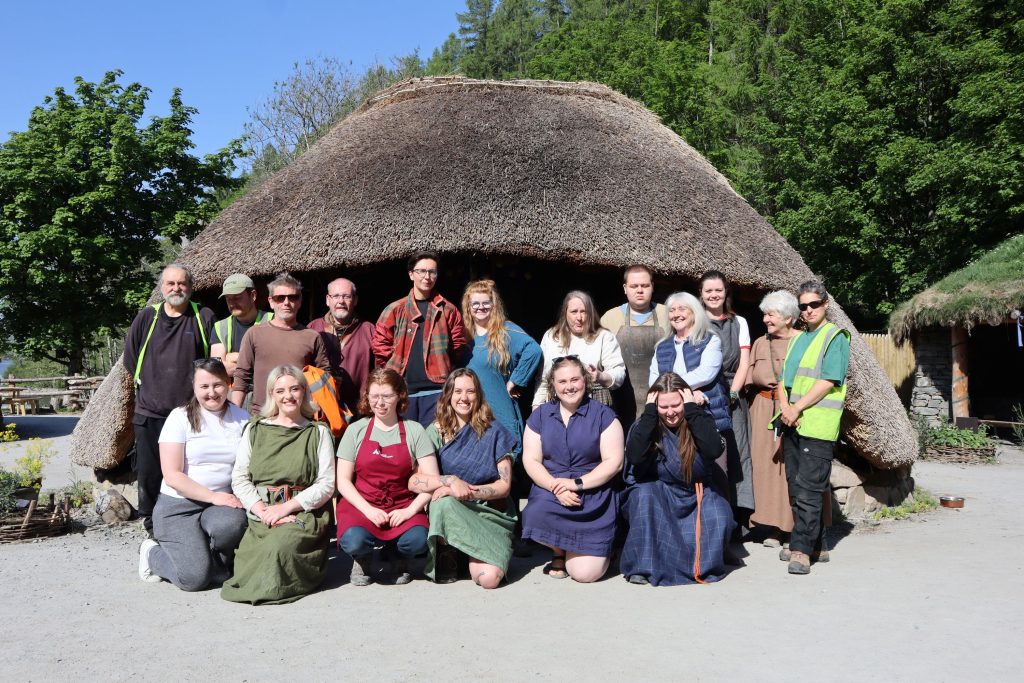
The Scottish Crannog Centre, located on Loch Tay in Perthshire, is an award‑winning museum and living history site dedicated to caring for, researching and sharing the stories of Scotland’s Iron Age crannogs. Through reconstructed dwellings, experimental archaeology, traditional crafts and immersive interpretation, the Centre brings to life how people lived, built and engineered over water some 2,500 years ago.
Since the original Interface‑supported project, the organisation has undergone a period of profound change. Following the devastating fire in 2021, the Centre relocated to a larger, better‑situated site at Dalerb on Loch Tay. This move accelerated its transformation from a successful but ageing visitor attraction into a values‑driven, museum‑focused organisation with social justice, sustainability and community at its heart. The Centre has since more than tripled its income, doubled staff numbers and embarked on a £6m redevelopment programme, including the construction of a new, full‑scale crannog using predominantly Iron Age techniques and materials.
All of this growth has been underpinned by long‑term collaboration with universities across Scotland, brokered and supported by Interface.
The Challenge
As the Centre evolved, it faced multiple, interconnected challenges:
- Modernising interpretation and exhibitions while retaining the authenticity and emotional power of hands‑on, outdoor heritage.
- Demonstrating the sophisticated engineering, sustainability and ingenuity of Iron Age building techniques in ways that are accessible to diverse audiences.
- Embedding social impact, community participation and sustainability into the DNA of a new national museum.
- Rebuilding resilience, capacity and confidence following the loss of the original crannog.
Meeting these challenges required specialist academic expertise, fresh perspectives and the capacity to experiment – resources that are difficult for a small cultural charity to access alone.
The Journey and Interface’s Role
Interface has played a sustained, strategic role since 2019, acting as a trusted connector between the Scottish Crannog Centre and academic expertise. Innovation Engagement Executive Lorna Watson worked closely with Director Mike Benson and the wider team to understand evolving ambitions and identify the right academic partners at each stage of development.
Rather than a single intervention, Interface enabled a portfolio of collaborations that grew alongside the organisation, spanning technology, engineering, design, sustainability, social impact, marketing and robotics. Over 20 projects have now been delivered, many supported by Scottish Funding Council Innovation Vouchers and follow‑on funding.
Key Collaborations and Developments
Immersive Technology and Interpretation (University of the West of Scotland)
The original Innovation Voucher project with UWS laid the foundations for a step‑change in interpretation. It delivered:
- A feasibility study for immersive and mixed‑reality heritage experiences.
- Designs for augmented exhibition spaces.
- Prototype VR and mobile‑based experiences.
These outputs informed the creation of a new gallery and continue to shape the Centre’s approach to storytelling, helping collections to “sing” to different audiences. The partnership has since expanded to include branding, marketing, student placements, VR development and sustainability‑focused projects, forming a long‑term strategic relationship.
Artefacts, Design and Creative Media (UWS & UHI)
Follow‑on projects that brought unseen artefacts to life and enhanced The Crannog brand include:
- A 3D printed replica of a rare Iron Age musical instrument bridge that visitors can handle.
- A student‑designed comic book aimed at educating children on Iron Age Scotland, the artefacts found on the excavation site and how they relate to life in 500BC. An authentic and meaningful project, the comic book is still sold in the centre today and the storyline drives the puppet show delivered to families throughout the season offering a great way to engage with younger audiences.
- An important piece of work involved the rebranding of The Crannog prior to the launch of the new site in 2025 following a £6 million development. Ewan Smith, a design student with UHI Perth developed the branding, delivered workshops to staff and volunteers, tested and honed the design coming up with the complete branding both physical and online for the opening of the new site at Dalerb.
Engineering the Iron Age (Heriot‑Watt University)
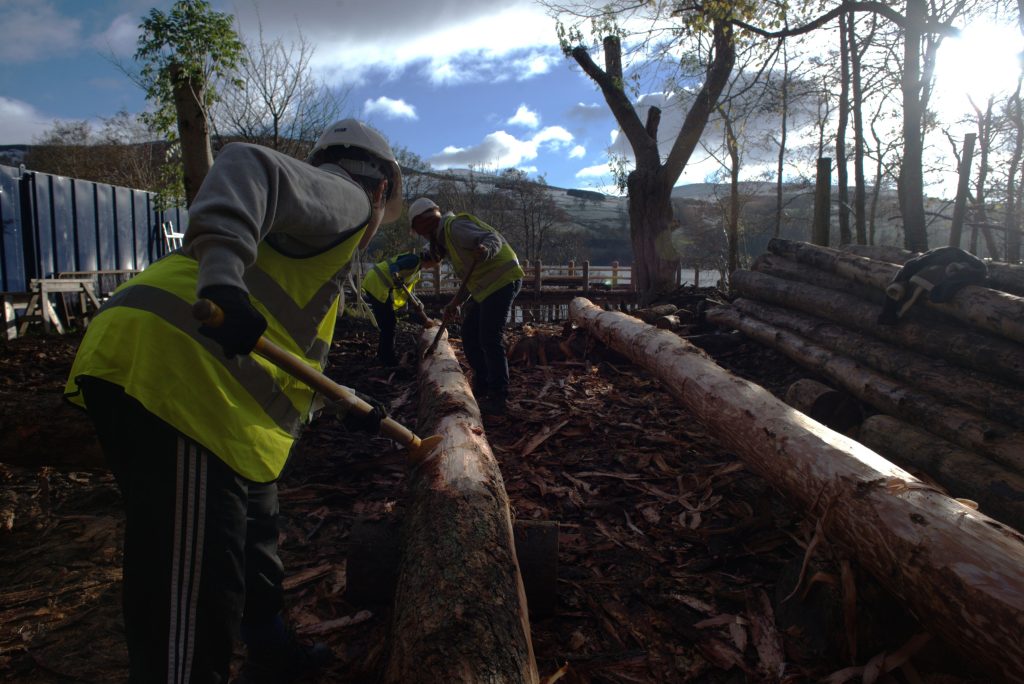
As part of the move to Dalerb, Interface connected the Centre with Heriot‑Watt University engineering students to explore the structural ingenuity of crannog construction. Working alongside craftspeople, archaeologists and engineers, students designed interactive model crannogs made from sustainable materials reclaimed from the main build.
These hands‑on models, launched in spring 2025, allow visitors to experiment with forces, stability and construction strategies, translating Iron Age engineering into playful, contemporary learning. For students, the collaboration reframed engineering beyond industrial contexts, highlighting sustainability, logic and longevity.
Measuring Social Impact and Sustainability (University of Glasgow)
A 2023/24 student placement focused on articulating the Centre’s societal impact. This work examined:
- Mentoring and work experience for local young people with additional support needs.
- Partnerships with organisations such as Glasgow Association for Mental Health, Maryhill Integration Network and UNESCO Refugee Integration through Languages and the Arts.
- The Centre’s four pillars of sustainability: people, partnerships, place and landscape.
The project helped evidence a sustainable museum model based on growing materials, skills, partners and audiences, supporting award submissions and future funding.
Film, Storytelling and the Rebuild (Edinburgh Napier University)
A filming placement documented the reconstruction of the new crannog, capturing traditional skills, community participation and the ambition to create a national museum with activism and inclusion at its core. This content supports interpretation, fundraising and digital engagement.
Looking Ahead: Social Robotics (University of Glasgow, 2026)
The next phase of innovation will explore human‑centred social robotics. In a co‑design research partnership, researchers will work with staff and visitors to prototype robots that enhance public engagement, for example, supporting tours or multilingual interpretation while reflecting the Centre’s values of inclusivity and care.
Impacts on the Organisation and Community
Organisational Growth and Resilience
- More than tripled income and doubled staff since relocation.
- Strengthened brand identity and national profile.
- Increased capacity to attract funding and deliver complex capital projects.
Innovation and Visitor Experience
- New galleries, interactive models, VR and tactile exhibits.
- Interpretation that connects ancient engineering, sustainability and contemporary challenges.
Community and Social Impact
- Deepened engagement with local communities, refugees, mental health organisations and young people with additional support needs.
- A co‑created museum shaped by “a thousand fingerprints and voices”.
Skills, Learning and Talent Pipeline
- Real‑world learning opportunities for students across engineering, design, media, computing and social sciences.
- A two‑way exchange where academic insight and lived heritage practice inform one another.
Academic Benefits
Academic partners have gained access to a rich, real‑world testbed for applied research and teaching. Students engage with authentic challenges, while universities strengthen their civic mission and visibility. Relationships have extended into advisory roles, placements, curriculum enrichment and long‑term research collaborations.
Moving Forward
The Scottish Crannog Centre demonstrates how sustained academic collaboration – enabled by Interface – can transform a small heritage organisation into a resilient, innovative, community‑centred national museum. Geography has proven no barrier to excellence; instead, partnership, curiosity and shared values have driven growth, impact and ambition far beyond the loch shore.
CreativeTech Scotland Gathering takes place on the 20th of June on the University of Edinburgh campus and promises to be an exciting day of cutting edge creative tech keynotes, demos and panels with workshops and a closing reception with live improvised electronic music from Boardgame.
The aim is to bring people together from across the creative and cultural sector in every discipline to meet, connect, share know-how, be inspired by new innovations and be amazed by how we each use creative technology to deliver our services, products and audience experiences.
The Programme will include a range of industry spotlights, hands-on workshops, and a showcase of creative tech demonstrations and lightening talks, with a closing reception and performance in Inspace with networking and refreshments.
The event will be hosted on The University of Edinburgh campus across the Informatics Forum, Inspace Gallery and the Student Enterprise Hub.
Full programme can be found here
Louise Arnold and Howell Davies of Interface will be attending this event.
On Tuesday 22 October 2024, join XR Network+ at Abertay University to find out about opportunities for collaboration, innovation and funding for researchers, companies and creatives in Scotland.
XR Network+ is a project led by the University of York that is bringing together academia and industry across the UK to deliver research and innovation in virtual production (VP) technologies. As one of 28 XR Network+ partners, Abertay University helped to co-create the XR Network+ themes spanning VP-related content creation and consumption that frame the project’s activities.
At the event, hear from another XR Network+ partner, the Royal Shakespeare Company, about their work around live performance including a research and development challenge for university-led project teams to develop new tools and pipelines for realtime performance capture in live theatre.
As the £75m CoSTAR (Convergent screen technologies and performance in realtime) project gears up to launch a network of R&D labs across the UK, discover what’s happening at the Realtime Lab in Dundee and the CoSTAR Live Lab in Wakefield. Led by the University of York and with close connections to XR Network+, the CoSTAR Live Lab team will develop technologies for future live performance experiences using virtual production, from small-scale pilots to arena-sized productions.
Find out about Immersive Arts, a new £6m project that will support UK artists to work with immersive tech. Led by the University of the West of England, Bristol, Immersive Arts aims to break down barriers for artists of all backgrounds to engage with immersive tools. As a cultural partner on the project, Glasgow-based Cryptic will support local artists to unlock the creative potential of new technology.
Agenda
4:00pm – Introduction to XR Network+ (Damian Murphy, Director of XR Stories and XR Network+ at the University of York)
4:20pm – Royal Shakespeare Company R&D Challenge project activities (Sarah Ellis, Director of Digital Development at the RSC)
4:50pm – CoSTAR Realtime Lab (Gregor White, Dean of Design & Informatics and Professor of Applied Creativity at Abertay University and Director of the CoSTAR Realtime Lab)
5pm – CoSTAR Live Lab (Helena Daffern, Professor in Music Technology at the University of York and Co-Director of the CoSTAR Live Lab)
5:25pm – Immersive Arts (Verity McIntosh, Associate Professor of Virtual and Extended Realities at UWE Bristol and Principal Investigator and Director of Immersive Arts)
6:00pm – Networking and light refreshments
7:00pm – Event finish
Location
Abertay University, CyberQuarter, Bell Street, Dundee, DD1 1HG, UK
Back as the headline event of Glasgow Tech Week, Glasgow Tech Fest is a must-attend event for the tech, digital, and creative communities in Glasgow and beyond. Glasgow Tech Fest will bring together visionary founders, seasoned leaders, insightful investors, ecosystem champions, and experts to connect, network, and share ideas and learnings in a day of keynotes, panels, and fireside chats.
Learn from industry experts and gain practical knowledge with this year’s themes:
- Investing in the future
- Developing inclusive and collaborative ecosystems
- Scale and Growth
- Entrepreneurial journeys
- Breaking barriers
Opening keynote launching Glasgow Tech Fest is the incredible Dame Dr Maggie Aderin-Pocock from BBC’s The Sky at Night! Stay tuned as more additions to the agenda are announced, guaranteed to be the ultimate tech event in Scotland!
- Are you a creative company, or in the GLAM sector, and innovating?
- Do you need help with data, technology, or research edge expertise?
- Can critical friends from academia help you see things from a new angle, solve problems and move forward?
Edinburgh College of Art invites you to a networking event on the 1st of March, 5-7PM, designed to bring together academics from throughout Edinburgh College of Art and selected external partners from a range of sectors, held at Inspace Gallery.
This is partly a chance to catch-up with partners we’ve worked with in the past but also to forge new connections with people who work in similar areas to explore opportunities to work together in the future, with 30 researchers from across ECA who are enthusiastic about making connections and impact with external partners.
The programme will be designed based on responses we get from invitees but, broadly speaking, there will be opportunities to present a problem, an idea, a call for collaboration in a short ‘pitch’ or to exhibit something, if desired. Both are optional, and there will be ample time for informal chats (with drink and nibbles!) Our researchers will be pitching their ideas and interests to you too.
Please e mail Claire at Claire.pembleton@ei.ed.ac.uk if you would like to attend by 5pm Friday 23 February.
The creative and heritage sectors are widely viewed as incredibly fertile spaces for innovation, consistently stepping outside the boundaries of traditional thinking to find new ways of working. As these sectors continues to navigate uncertainly, now more than ever, businesses, organisations and networks are looking to reach their customers in different ways and develop new processes, services and products. However, from identifying possible areas of innovation- to articulation, funding and undertaking R&D – embarking on the journey can seem like a daunting and complicated process.
In this practical workshop, John Mackenzie, Senior Development Manager for Innovation at Highlands and Islands Enterprise (HIE), will break down their range of innovation services, how to access them and talk through the dynamic opportunities it could offer the creative and heritage sectors.
John Mackenzie provides innovation support to both HIE staff and clients providing advice on innovation funding, IP, access to external expertise and support on how to structure an innovation project. He is also HIE’S lead on their partnerships with the Censis and Best innovation centres, the advanced manufacturing cluster builder programme, and Interface.
Background
Smartify is a tech company originally based out of London. It has developed an online platform serving the arts, culture and heritage sector, connecting destinations with their visitors. It provides cultural institutions with cutting-edge digital capabilities to manage the visitor experience; and at the same time, it acts as a platform to help them reach a broader audience. Smartify currently has a reach of over 4 million users as of June 2023.
The Challenge
Smartify was looking to develop its XR (Extended Reality) infrastructure to allow the company to develop experiences which could be easily scaled in a cost-effective manner and across multiple platforms (iOS, Android and Web). Smartify were needing to develop a novel XR platform to be integrated within the Smartify app. They were looking for academic expertise in AR/VR/XR but also an understanding of the tourism and heritage sector.
The Solution
Smartify were already an active member of the Travel Tech for Scotland (TTfS) community with a strong customer base including Scottish National Galleries, Kelvingrove, National Museums of Scotland, Blair Castle, Highlife Highland, and National Trust for Scotland.
Lesley Judge of TTfS referred Smartify to Interface who made them aware of the *Inward Investment Catalyst Fund. Through Interface’s search and matchmaking services, Smartify were introduced to Dr Marco Gilardi from the Division of Computing at the University of the West of Scotland, who has a wealth of experience in AR/VR/XR and has been part of an academic group providing knowledge exchange on this subject for the tourism and heritage sector.
The project aimed to support the company in developing XR applications using web technologies and, in the process, help them develop their market presence in Scotland. The objective of the project was to develop proof of concepts and test them with the market which was achieved successfully with a commercial project delivered as result.
*The Inward Investment Catalyst Fund has been set up by Interface and the Scottish Government to attract and support businesses, not yet located in Scotland to collaborate with academic institutions on their research and development activity to strengthen the case for developing a base in Scotland.
The Benefits
For the Company
- Development of prototype IP leading to continued building of tech infrastructure and creative pipeline
- Helped Smartify create a clear tech capabilities roadmap and strategy through a better understanding of the existing technology landscape, capabilities, limitations and opportunities
- Enabled a pipeline of projects and helped secure a further contract with major Scottish National cultural institutions.
For the University
- Established a sustained and strategic partnership with an innovative tech company
- Supported a PhD student to gain hands-on industry experience
- Has led to further knowledge transfer activity namely an Accelerated Knowledge Transfer to Innovate Project and a further Knowledge Transfer Partnership
For Scotland
- Smartify have set up a Scottish division, creating two new jobs and they have projected that this will double annually over the next three years