
Overview
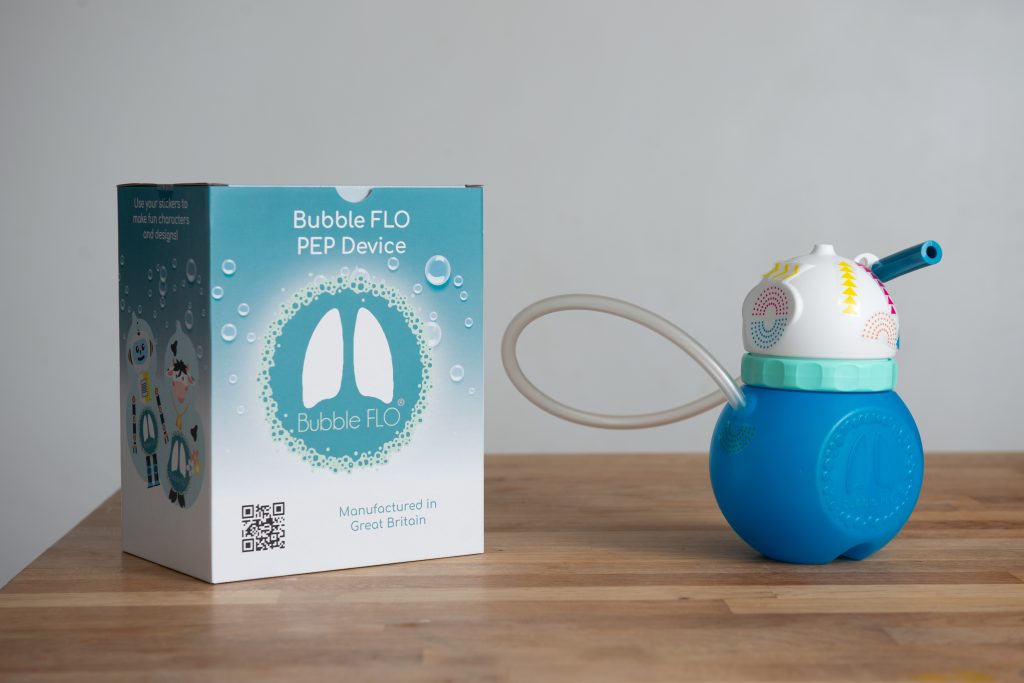
Bubble FLO® has created a fun, child friendly, visually engaging, and effective physiotherapy medical device the Bubble FLO® PEP (Positive Expiratory Pressure) Device for the treatment of chronic lung conditions.
Background
Bubble FLO® was set up by Katie Vance to develop a child friendly, engaging and effective physiotherapy medical device- a Bubble Positive Expiratory Pressure (PEP) Device for the treatment of chronic lung conditions.
Positive-expiratory-pressure (PEP) therapy is a respiratory therapy that applies resistance to expiration, to produce positive airway pressure. Since the 1930s, PEP has been used to improve oxygenation, increase lung volume and reduce venous return in patients with congestive heart failure. PEP improves collateral ventilation, secretion clearance, aerosol distribution and functional residual capacity. (Respiratory Care:April 2009, Vol 54, No.4)
Challenge
The idea of creating a Bubble PEP device evolved when Katie’s daughter was diagnosed with a lifelong respiratory condition and the equipment supplied to carry out vital twice daily physiotherapy was very basic and lacked visual engagement for children. Katie discovered there was no specific Paediatric equipment available, so she decided to develop a Bubble PEP Device which was fun, engaging and effective in clearing secretions from the lungs, and that was aesthetically pleasing, easily portable and easy to empty and re-fill.
The technology did not exist to meet these key practical needs and Katie recognised that such a product could be revolutionary in this critical field. The prototype that she developed was given very positive feedback from physiotherapists who worked with Katie’s daughter, and they expressed a need for a similar device for use by other patients and so Bubble FLO® was born.
Solution
To develop the concept Katie contacted Interface, who, after putting out a search to Scotland’s universities and research institutes, partnered her with Kath Sharp, NHS Team Lead in Paediatric physiotherapy at Glasgow Caledonian University, (who introduced the technique to the West of Scotland and acted as a consultant on the project), and Professor Terence Gourlay, from the University of Strathclyde’s Biomedical Engineering Department, who has extensive experience in the design, development and commercialisation of medical devices.
This collaborative project, funded by a Scottish Funding Council Innovation Voucher, focused on the development of a novel respiratory improvement technology aimed at the paediatric sector, but based on known and well-established approaches. The novelty in the proposed approach is centred around making what can be a tiresome therapy for children, fun and engaging.
The experience the Department of Biomedical Engineering has in the production of laboratory, test-ready prototype devices was applied to the project to produce near clinically deliverable prototypes of the proposed technology which were then successfully tested under laboratory conditions.
Subsequently Bubble FLO® was awarded a By Design Grant from Scottish Enterprise, which allowed the prototype design and ergonomics to be developed further.
Through the support of South of Scotland Enterprise, Bubble FLO® worked with an engineer to develop manufacturing tools, create 40 prototypes and completed bio burden and chemical compatibility testing.
Regulatory work has been completed with the support of CPI and Innovate UK to ensure the product is suitable for use.
BubbleFLO are hoping to start clinical trials with the West of Scotland Innovation Hub at the Royal Hospital for Children in Glasgow soon.
Interface have continued to assist Bubble FLO® brokering collaborations with the University of Strathclyde to create a brand and marketing strategy to target families of children with respiratory conditions and with Edinburgh Napier University to develop a “How to Set Up and Use” animated video with the aim of using animated characters to turn what can be a very daunting experience for a child into a fun and engaging one.
Benefits
As the Bubble FLO® PEP Device will be more engaging for children than the current NHS equipment; children will be much more motivated to carry out effective physiotherapy sessions and, in turn, this has the potential to save the NHS budget considerably through a reduction in hospital admissions for respiratory treatment.
Whilst initially, sales of the Bubble FLO® PEP Device will be to parents online, it is hoped the NHS will purchase this new medical equipment as a long-term investment to reduce their overall budget after completion of an upcoming clinical trial with the West of Scotland Innovation Hub, Royal Hospital for Children in Glasgow.
The development of the proposed technology will underpin the foundation of the commercial activity around this novel product. The company have benefitted from the University’s expertise in the development of prototypes, their laboratory evaluation and expertise in tooling design and production of the medical devices.
Subsequent collaborations have provided Bubble FLO® with a marketing and targeting strategy and produced a novel animated guide for children and parents to be able to use the device at home.
The academic partner has benefitted through this new research activity in the paediatric respiratory sector and in the use of this project as a case study for teaching purposes. In addition, the project fits very well with the Department’s objective of being supportive of the Scottish life science and med tech sectors.
This project was nominated for Innovator of the Year at the Scottish Knowledge Exchange Awards and won a Wild Card at the Scottish EDGE.
This is a collaborative event for everyone interested in engaging in health and life sciences innovation in the Highlands and Islands. Hosted by Highlands and Islands Enterprise, NHS Highland and the University of the Highlands and Islands at the new Life Sciences Innovation Centre on the Inverness Campus.
This event will highlight mechanisms and routes for growing health innovation opportunities throughout the Highlands and Islands. This includes regional expertise, infrastructure, funding and services available within HIE, NHS Highland, and UHI, as well as through relevant regional and national partner organisations.
This event is open to all involved parties in health science (including in MedTech and Digital Health) such as entrepreneurs and third sector organisation interested in health product and service development, evaluation and assessment, as well as implementation for clinical and/or commercial benefit. NHS staff from outside Highland are welcome along with anyone in the health and social care sector.
The SCOUT Project, in partnership with PwC UK LLP, is running an innovation clinic for SME leaders and line managers to gain insights from industry experts on what lies ahead for the sector and how SMEs can best take advantage of upcoming future opportunities. Topics up for discussion will include; Designing your operating model; R&D Tax Credits and incentives; Moving into manufacturing and Getting support.
In addition, attendees will also be granted a guided tour of the new, state-of-the-art Medicines Manufacturing Innovation Centre, hearing first-hand about the exciting work already underway within this world leading, carbon neutral facility – including how cutting edge technologies are delivering; a reduction of API, solvent and energy usage in manufacturing; leveraging digital twins to maximise operational efficiency; and reducing <50% wastage in automated clinical trial manufacture.
Spaces are limited, and demand is expected to be high, so book your place today by emailing ERDF.SCOUT@uk-cpi.com.
The SCOUT Project is a fully funded service which aims to accelerate and de-risk the growth of Scottish SMEs in chemical, biochemical and life science sectors, who are seeking or developing disruptive technologies and is jointly funded by the European Regional Development Fund (managed by Scottish Enterprise) CPI, CMAC Future Manufacturing Research Hub (CMAC) and the Industrial Biotechnology Innovation Centre (IBioIC).
The Medical Device Manufacturing Centre (MDMC) is hosting its 2nd Annual Conference which will bring together industry, NHS and academia to discuss the latest services offered by stakeholders in the life sciences and healthcare sector.
This conference is unique in its breadth and offers the opportunity for delegates to find out more about initiatives set by the NHS and government, as well as learn about the latest advances by companies in the sector.
It will provide invaluable networking opportunities and companies will be offered free exhibition space on a first come, first served basis. Academia will have the opportunity to present their research work through a posters exhibition.
If you are interested in the latest MedTech news and tips, or seek further insight into growing your business, come along and be a part of this invaluable opportunity to network with like-minded individuals, companies and stakeholders in the Scottish life sciences and healthcare sector.
Programme:
The morning session focus is on the services that SMEs can access to accelerate innovation.
The afternoon session will explore the activities and services in health and care offered by organisations such as Scottish Enterprise, the Centre for Process Innovations (CPI), and the Digital Health and Care Innovation Centre (DHI-Scotland).
About MDMC
The mission of the MDMC is to provide expert advice on manufacturing engineering, regulatory issues and funding, coupled with technically supported access to manufacturing facilities, to assist small- and medium-sized companies in the translation of medical device concepts through to small batch commercial prototypes. Services provided by the MDMC are free of charge to SMEs, with priority to Scottish SMEs at all times.
A consortium of 4 universities led by Heriot-Watt and funded from the Advancing Manufacturing Challenge Fund (AMCF) and the Edinburgh City Deal, the MDMC offers medical device development and manufacture in Scotland, providing companies with an enabling step towards first-in-patient-studies.
Join Innovate UK KTN at the University of Strathclyde Technology and Innovation Centre to explore all things microbiome across the One Health Microbiome spectrum including human, animal, plant, and environment.
Bringing these sectors together is an opportunity to learn from each other and make new connections.
The conference will explore common challenges and discuss how the community can work together to make the UK a key destination in Europe for microbiome research and innovation.
There will also be an opportunity for early-stage microbiome entrepreneurs to pitch their ideas to find new partners.
- Meet with leading microbiome researchers and innovators from academia and industry.
- Learn about advances being made in microbiome research and innovation across different sectors.
- Understand common challenges and solutions across the different sectors involved in microbiome research and innovation.
- Hear from some of the UK’s pioneering microbiome start-ups and experts in IP, regulatory and manufacturing.
- Forge new connections and collaborations that could fast-track your research or project.
- Join the UK’s microbiome innovation community.
This event is for:
- Academics
- Industry scientists
- Entrepreneurs
- Supporting organisations
- Funders
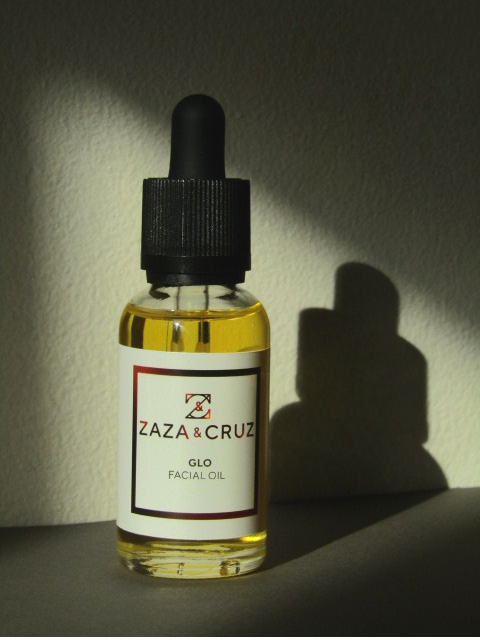
ZAZA & CRUZ to create a unique natural skincare blend using by-products of the whisky distillation process to rejuvenate and moisturize the skin whilst also shielding against cellular damage and anti-aging.
Background
ZAZA & CRUZ is a natural skin care company that aims to provide high-quality natural ingredients at a reasonable price. Its mission is to make its customers feel confident in their skin.
Rebecca Hastings, a makeup artist, and beauty specialist founded the company in 2013. Her children inspired the company’s name. As a make-up artist, she became increasingly concerned about what was in the products applied to the skin of her clients and her children. Consequently, she researched the most beneficial natural oils and botanicals in 2011 and created her unique natural blend of ingredients that rejuvenated and moisturized the skin while also shielding against cellular damage and anti-aging.
The Challenge
Kirsty of Interface met Rebecca at a HIE event in 2019, where they discussed the innovation potential of her business. They chatted about the beneficial effects on aging of the skin that the sake yeast fermentation process was proven to have by a Japanese company SK 11 in the 1970’s. The resulting complex that was created is now used throughout the whole Japanese skincare range. This led on to a conversation about the potential of whisky in skincare.
ZAZA & CRUZ were looking to use natural ingredients and processes to develop an active antioxidant/enzyme extract from whisky which would help with skin rejuvenation and could be used in their luxury skincare range.
Rebecca, founder of ZAZA & CRUZ was seeking to find out if the antioxidants and enzymes produced during the whisky distilling process could prove beneficial for skin rejuvenation in collagen and cell turnover, and if they could be extracted to become a natural ingredient in her skincare products.
The use of the findings will enable ZAZA & CRUZ to infuse a brand of whisky into their luxury skincare line. This in turn will benefit the partner of the whisky brand to tap into a wider cosmetics market.
The Solution
Robert Gordon University came forward to support Rebecca’s ideas, and Kirsty stayed on hand to support Rebecca with discussions. Rebecca felt that the expertise and enthusiasm from the team at RGU were the right fit for her and so moved forward with an Innovation Voucher
The project focussed on extraction, analysis and testing to discover and prove that the active and complex mix of antioxidants, enzymes and plant phenols released from whisky during the distillation and fermentation process could be extracted and provide a natural and safe solution for the skin which could then be used in the whole luxury line of skincare products for the consumer.
Firstly, the project looked at the antioxidant capacity of pot ale and effluent samples from whisky distillation using different assays as well as evaluating their toxicity at a cellular level. This was then applied into the formulation of the skincare products. Finally, an assessment of their antioxidant activity, that is, their protective effects on skin, was investigated. It was found that placing the nutrients from whisky in skincare can help to boost the skin and help fight free radical damage from the environment. In addition, polyphenols from whisky have the added benefit of helping to reduce inflammation, puffiness, and calms redness in the skin; making is a great ingredient to use in a moisturiser every day.
The findings from this collaboration will enable ZAZA & CRUZ to infuse a brand of whisky products into their luxury skincare line that can benefit consumers’ skin.
The Benefits
The benefits to ZAZA & CRUZ:
- Being able to work with a highly specialized and qualified team at RGU with great knowledge of the extraction process for antioxidants.
- A better understanding about the process of extraction and how to adopt a more scientific approach towards testing and incorporating ingredients into skincare products.
- Quality results that can be used to push the project forward and be innovative in the skincare industry.
About Opportunity:
It is estimated that companies around the world lose a total of $1.8 trillion annually (UK economy, £30 billion) due to counterfeited products. While counterfeiting imposes a challenge on every industry, the pharmaceutical and alcoholic beverage industry (e.g. Whisky producers) are affected most, since forged products can have life threatening implications. In fact, it is estimated that the deaths of up to one million people each year can be related to toxic or ineffective counterfeited drugs. Current product security features include raised printing, watermarks, micro-lettering, holograms and security inks. While these technologies contribute to the overall counterfeit resilience, the current security features are still often forged. Similarly, official documents such as passports or banknotes are prime candidates for counterfeiting. For example, in 2016, counterfeit Sterling bank notes with a face value £7.5 million were removed from circulation by the Bank of England, highlighting an ever-increasing need for sophisticated and counterfeit resilient security features.
Our distributed feedback membrane laser technology addresses this need and could become a widely applied and versatile security feature on valued documents or similar products. Due to their extreme mechanical flexibility, ultra-low weight and ultra-thin design, these membrane lasers can be applied to banknotes or other documents requiring authentication control to serve as unique security labels. Up to (10e15)n unique labels for (n different gain materials) can be created and read out using a simple contactless optical system. The specialist expertise and technology facilities needed to produce the lasers will make them almost impossible to counterfeit, rendering it a strong and reliable security feature. Furthermore, the high optical transparency of the membrane lasers, combined with their low thresholds and ultrathin design also allows their use as wearable security tags, even on contact lenses where they can complement biometric authentication with iris scans.
Key Benefits:
- Extremely flexible, ultrathin (< 500 nm) and ultralow weight (0.5 g/m2) membrane lasers
- Transferable to any object requiring authentication control (e.g. banknotes, passports, branded goods, pharmaceuticals, etc.)
- 10e15 unique barcode-like labels can be created
- High read-out stability under ambient conditions
- Straightforward contactless read out using a simple optical system
- High counterfeit resilience due to a sophisticated production procedure
- Uses low-cost mass-scale production via inkjet printing techniques and roll-to-roll processes
Applications:
- Banknotes
- Passports
- Branded goods
- Pharmeceuticals
IP Status:
The University filed UK Patent Application No. 1711097.4 on 10th July 2017 and has subsequently prepared EP and US national phase filings.
About Opportunity
Researchers at the University of Glasgow have developed a Wireless Electroencephalogram Neuro-feedback System for rehabilitation and the treatment of chronic pain. Neuro-feedback uses real-time displays of brain activity—most commonly (EEG), to teach self-regulation of brain function.
Typically, sensors are placed on the scalp to measure activity, with measurements displayed using visual displays or sound. DrAlexsandra Vuckovic has been developing and validating a Neuro-feedback system for the neuro-rehabilitation of hand function and central neuropathic pain in patients with paralysis of the upper extremities (tetraplegia).
The core university innovation is the brain-computer interface software to analyse and visualise selected features of the EEG brain signals to patients in the form of a graphical user interface on a computer screen. The visual information gives the patient information about their brain activity which they can use to modulate this activity in a desired direction. The main hardware components of the system are commercially available as an expensive EEG device initially designed for gaming and a tablet computer.
In software developed for rehabilitation of the hand, the system detects when the person is attempting to move their hand based on EEG measurement. This signal is then used to activate a functional electrical stimulator (FES) device to achieve the desired movement. Thus when a paralysed person attempts to use their hand, a ‘though driven’ FES activates hand muscles.
The second application of the system is for ‘brain training’ in spinal cord injured patients for relief of chronic nerve pain. It targets EEG based ‘signatures’ of pain and patients can see a computer screen graphical presentation of their brain activity, learning to regulate that activity at will.
Key Benefits
- The trials have demonstrated that spinal cord injured patients who used the brain-computer interface software therapy achieved better neurological recovery than patients who received ‘passive’ functional electrical stimulator (FES) therapy.
- A daily 30 minutes of the brain training system results in reduced pain over a period of several hours to several days.
- The technology has been validated through a registered clinical trial on patients in the Queen Elizabeth National Spinal Injuries Unit at the Queen Elizabeth University Hospital.
Applications
- The Wireless EEG Neuro-feedback System have been developed to address two major problems of spinal cord injured people; rehabilitation of hand function and chronic central neuropathic pain.
- A common feature for these two applications is that they are based on active brain training that promotes neurological recovery.
IP Status
Contact is welcomed from organisations interested in developing, licensing or exploiting this IP with a view to commercialisation.
About Opportunity
Following injury or disease, an organism undergoes a variety of (natural or induced) processes to direct cells, tissues and cellular processes towards healing and eventually regeneration. These processes generally involve growth factors (GFs), substances that control cell function through the activation of specific signalling pathways and that are capable of stimulating cellular growth, proliferation, and cellular differentiation.
rhBMP-2 is a powerful growth factor that is essential in tissue morphogenesis and is utilised to promote bone growth in trauma, spine and maxillofacial clinical applications. Current clinical delivery has however encountered serious complications associated with the high doses used.
The technology is based on synthetic materials that allow the simultaneous and co-localised signalling between growth factor receptors and integrins. These polymeric materials organise fibronectin (FN), an important protein of the extracellular matrix, and sequester rhBMP-2 in synergy with the integrin binding region to direct stem cell differentiation in vitro.
In vitro testing and animal models have demonstrated that this new technology enhances bone regeneration and vascularisation with much lower and safer rhBMP-2 doses (< 5 mg/cm3). Results are comparable to the higher doses used currently in the clinic (~ 1.5 mg/cm3), which makes the technology robust in terms of safety, effectiveness and economically competitive to current commercially available products.
Current commercial uses of rhBMP-2 growth factor can be complicated, adsorbed in collagen sponges or other materials at high doses. The GF Synergy technology has been developed with these challenges in mind for easy integration into medical devices and implants manufacturing. The base materials can be manufactured in the form of biocompatible implantable constructs and orthobiology products. For regeneration applications the materials can be coated on bioabsorbable materials already commonly used in medical devices.
Key Benefits
Safer, minimal dose delivery of recombinant human bone morphogenetic protein-2 (rhBMP-2) for bone tissue engineering.
Easy to develop into commercial clinical products, as the technology is acellular and requires only use of autologous or recombinant human proteins and growth factors.
Control of synergistic signalling between cell adhesion and growth factor receptors as in physiological environments
Based on synthetic materials commonly used in other biomedical approved applications
Applications
Clinical bone regeneration – the GF Synergy technology can be used to make bone substitutes for non-union fractures, materials for spinal fusion procedures, and to improve long term stability of implants.
Stem cell/osteoblast research – The technology is useful to academics interested in studying bone differentiation in cell culture research projects
Pharma – the device provides ‘clean’ osteogenesis in 2D and 3D and so will be useful in the study of drugs for e.g. osteoporosis, osteogenesis imperfect etc.
IP Status
Contact is welcomed from organisations interested in developing, licensing or exploiting this IP with a view to commercialisation.