
“What can I say – we have worked alongside colleagues at Interface since 2019 with over 20 different projects under our belt. Each project has sharpened and nudged us forward. This genuine relationship has also led to a long‑term partnership with UWS and connections with multiple universities. From immersive tech to engineering, sustainability and now social robotics, Interface has helped us open ourselves up to fresh, innovative thinking with real impact. It’s a win‑win‑win.”
Mike Benson, Director, The Scottish Crannog Centre
Background
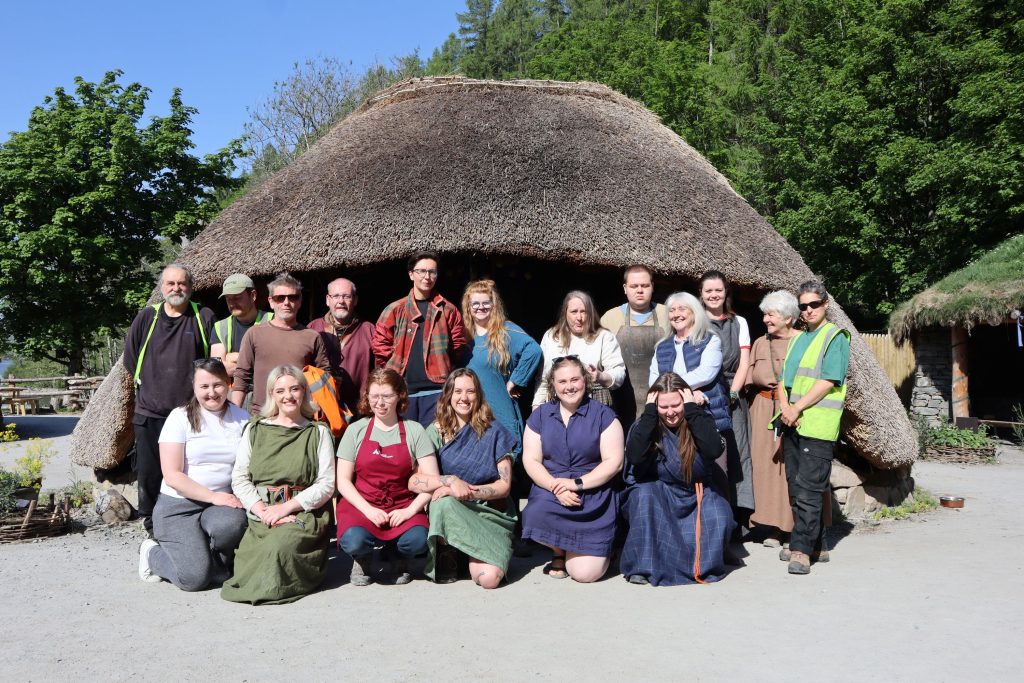
The Scottish Crannog Centre, located on Loch Tay in Perthshire, is an award‑winning museum and living history site dedicated to caring for, researching and sharing the stories of Scotland’s Iron Age crannogs. Through reconstructed dwellings, experimental archaeology, traditional crafts and immersive interpretation, the Centre brings to life how people lived, built and engineered over water some 2,500 years ago.
Since the original Interface‑supported project, the organisation has undergone a period of profound change. Following the devastating fire in 2021, the Centre relocated to a larger, better‑situated site at Dalerb on Loch Tay. This move accelerated its transformation from a successful but ageing visitor attraction into a values‑driven, museum‑focused organisation with social justice, sustainability and community at its heart. The Centre has since more than tripled its income, doubled staff numbers and embarked on a £6m redevelopment programme, including the construction of a new, full‑scale crannog using predominantly Iron Age techniques and materials.
All of this growth has been underpinned by long‑term collaboration with universities across Scotland, brokered and supported by Interface.
The Challenge
As the Centre evolved, it faced multiple, interconnected challenges:
- Modernising interpretation and exhibitions while retaining the authenticity and emotional power of hands‑on, outdoor heritage.
- Demonstrating the sophisticated engineering, sustainability and ingenuity of Iron Age building techniques in ways that are accessible to diverse audiences.
- Embedding social impact, community participation and sustainability into the DNA of a new national museum.
- Rebuilding resilience, capacity and confidence following the loss of the original crannog.
Meeting these challenges required specialist academic expertise, fresh perspectives and the capacity to experiment – resources that are difficult for a small cultural charity to access alone.
The Journey and Interface’s Role
Interface has played a sustained, strategic role since 2019, acting as a trusted connector between the Scottish Crannog Centre and academic expertise. Innovation Engagement Executive Lorna Watson worked closely with Director Mike Benson and the wider team to understand evolving ambitions and identify the right academic partners at each stage of development.
Rather than a single intervention, Interface enabled a portfolio of collaborations that grew alongside the organisation, spanning technology, engineering, design, sustainability, social impact, marketing and robotics. Over 20 projects have now been delivered, many supported by Scottish Funding Council Innovation Vouchers and follow‑on funding.
Key Collaborations and Developments
Immersive Technology and Interpretation (University of the West of Scotland)
The original Innovation Voucher project with UWS laid the foundations for a step‑change in interpretation. It delivered:
- A feasibility study for immersive and mixed‑reality heritage experiences.
- Designs for augmented exhibition spaces.
- Prototype VR and mobile‑based experiences.
These outputs informed the creation of a new gallery and continue to shape the Centre’s approach to storytelling, helping collections to “sing” to different audiences. The partnership has since expanded to include branding, marketing, student placements, VR development and sustainability‑focused projects, forming a long‑term strategic relationship.
Artefacts, Design and Creative Media (UWS & UHI)
Follow‑on projects that brought unseen artefacts to life and enhanced The Crannog brand include:
- A 3D printed replica of a rare Iron Age musical instrument bridge that visitors can handle.
- A student‑designed comic book aimed at educating children on Iron Age Scotland, the artefacts found on the excavation site and how they relate to life in 500BC. An authentic and meaningful project, the comic book is still sold in the centre today and the storyline drives the puppet show delivered to families throughout the season offering a great way to engage with younger audiences.
- An important piece of work involved the rebranding of The Crannog prior to the launch of the new site in 2025 following a £6 million development. Ewan Smith, a design student with UHI Perth developed the branding, delivered workshops to staff and volunteers, tested and honed the design coming up with the complete branding both physical and online for the opening of the new site at Dalerb.
Engineering the Iron Age (Heriot‑Watt University)
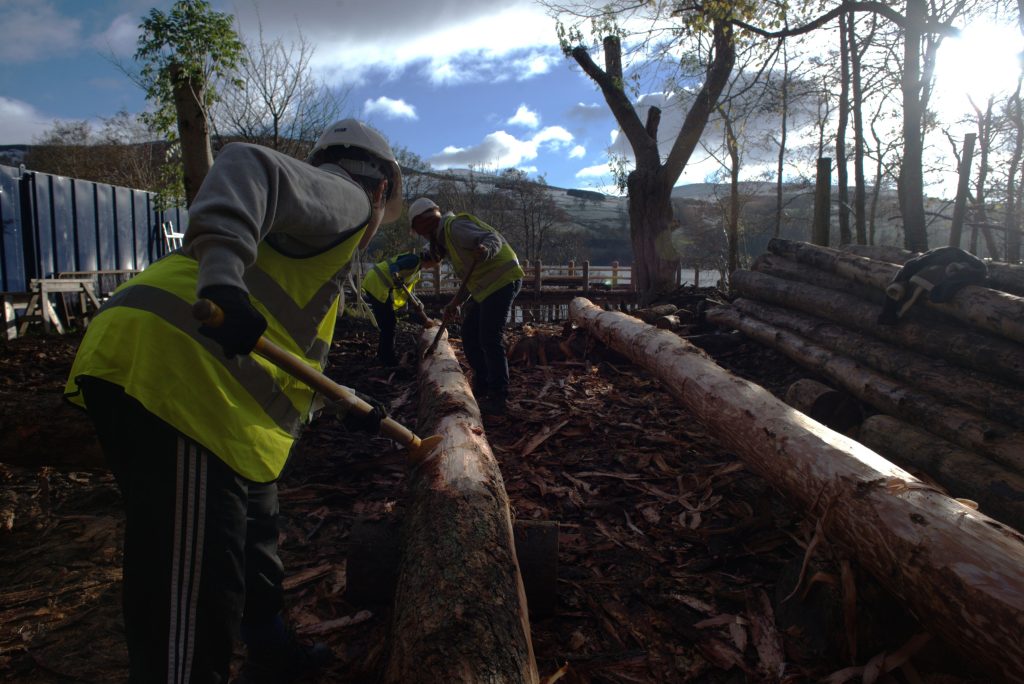
As part of the move to Dalerb, Interface connected the Centre with Heriot‑Watt University engineering students to explore the structural ingenuity of crannog construction. Working alongside craftspeople, archaeologists and engineers, students designed interactive model crannogs made from sustainable materials reclaimed from the main build.
These hands‑on models, launched in spring 2025, allow visitors to experiment with forces, stability and construction strategies, translating Iron Age engineering into playful, contemporary learning. For students, the collaboration reframed engineering beyond industrial contexts, highlighting sustainability, logic and longevity.
Measuring Social Impact and Sustainability (University of Glasgow)
A 2023/24 student placement focused on articulating the Centre’s societal impact. This work examined:
- Mentoring and work experience for local young people with additional support needs.
- Partnerships with organisations such as Glasgow Association for Mental Health, Maryhill Integration Network and UNESCO Refugee Integration through Languages and the Arts.
- The Centre’s four pillars of sustainability: people, partnerships, place and landscape.
The project helped evidence a sustainable museum model based on growing materials, skills, partners and audiences, supporting award submissions and future funding.
Film, Storytelling and the Rebuild (Edinburgh Napier University)
A filming placement documented the reconstruction of the new crannog, capturing traditional skills, community participation and the ambition to create a national museum with activism and inclusion at its core. This content supports interpretation, fundraising and digital engagement.
Looking Ahead: Social Robotics (University of Glasgow, 2026)
The next phase of innovation will explore human‑centred social robotics. In a co‑design research partnership, researchers will work with staff and visitors to prototype robots that enhance public engagement, for example, supporting tours or multilingual interpretation while reflecting the Centre’s values of inclusivity and care.
Impacts on the Organisation and Community
Organisational Growth and Resilience
- More than tripled income and doubled staff since relocation.
- Strengthened brand identity and national profile.
- Increased capacity to attract funding and deliver complex capital projects.
Innovation and Visitor Experience
- New galleries, interactive models, VR and tactile exhibits.
- Interpretation that connects ancient engineering, sustainability and contemporary challenges.
Community and Social Impact
- Deepened engagement with local communities, refugees, mental health organisations and young people with additional support needs.
- A co‑created museum shaped by “a thousand fingerprints and voices”.
Skills, Learning and Talent Pipeline
- Real‑world learning opportunities for students across engineering, design, media, computing and social sciences.
- A two‑way exchange where academic insight and lived heritage practice inform one another.
Academic Benefits
Academic partners have gained access to a rich, real‑world testbed for applied research and teaching. Students engage with authentic challenges, while universities strengthen their civic mission and visibility. Relationships have extended into advisory roles, placements, curriculum enrichment and long‑term research collaborations.
Moving Forward
The Scottish Crannog Centre demonstrates how sustained academic collaboration – enabled by Interface – can transform a small heritage organisation into a resilient, innovative, community‑centred national museum. Geography has proven no barrier to excellence; instead, partnership, curiosity and shared values have driven growth, impact and ambition far beyond the loch shore.
On Tuesday 22 October 2024, join XR Network+ at Abertay University to find out about opportunities for collaboration, innovation and funding for researchers, companies and creatives in Scotland.
XR Network+ is a project led by the University of York that is bringing together academia and industry across the UK to deliver research and innovation in virtual production (VP) technologies. As one of 28 XR Network+ partners, Abertay University helped to co-create the XR Network+ themes spanning VP-related content creation and consumption that frame the project’s activities.
At the event, hear from another XR Network+ partner, the Royal Shakespeare Company, about their work around live performance including a research and development challenge for university-led project teams to develop new tools and pipelines for realtime performance capture in live theatre.
As the £75m CoSTAR (Convergent screen technologies and performance in realtime) project gears up to launch a network of R&D labs across the UK, discover what’s happening at the Realtime Lab in Dundee and the CoSTAR Live Lab in Wakefield. Led by the University of York and with close connections to XR Network+, the CoSTAR Live Lab team will develop technologies for future live performance experiences using virtual production, from small-scale pilots to arena-sized productions.
Find out about Immersive Arts, a new £6m project that will support UK artists to work with immersive tech. Led by the University of the West of England, Bristol, Immersive Arts aims to break down barriers for artists of all backgrounds to engage with immersive tools. As a cultural partner on the project, Glasgow-based Cryptic will support local artists to unlock the creative potential of new technology.
Agenda
4:00pm – Introduction to XR Network+ (Damian Murphy, Director of XR Stories and XR Network+ at the University of York)
4:20pm – Royal Shakespeare Company R&D Challenge project activities (Sarah Ellis, Director of Digital Development at the RSC)
4:50pm – CoSTAR Realtime Lab (Gregor White, Dean of Design & Informatics and Professor of Applied Creativity at Abertay University and Director of the CoSTAR Realtime Lab)
5pm – CoSTAR Live Lab (Helena Daffern, Professor in Music Technology at the University of York and Co-Director of the CoSTAR Live Lab)
5:25pm – Immersive Arts (Verity McIntosh, Associate Professor of Virtual and Extended Realities at UWE Bristol and Principal Investigator and Director of Immersive Arts)
6:00pm – Networking and light refreshments
7:00pm – Event finish
Location
Abertay University, CyberQuarter, Bell Street, Dundee, DD1 1HG, UK
This Conference will bring together everyone interested in the development of agritourism in Scotland.
It will be a great chance to get together, network and build relationships.
The conference is set to welcome:
- existing agritourism business owners
- farmers and crofters considering agritourism or just keen to find out more
- tourism, hospitality and food and drink businesses keen to benefit from the growth of agritourism in Scotland
- professionals and suppliers to the sector
- industry representatives from across agriculture, tourism destinations, the public sector and academia
Both members of Scottish Agritourism and non-members are welcome. Anyone booking with a non-members ticket who decides to join Scottish Agritourism before or during the Conference will have the difference in their ticket money refunded.
Highlights will include:
- Building Great Teams – Beata Winiarska, Forest Farm Dairy, Anna & Richard, Lindores & Sarah Heward, The Real Food Cafe.
- Innovation – Jillian McEwan, Lunan Bay Farm, Tom Lewis, Monachyle Mhor, Katrina Reynolds, Allanton Inn, & Rob Bebbington, Alderford.
- International session – Marijke Dunselman, Agritourism New Zealand & Pandurang Taware, Agritourism India
- Insight Session, Vicki Miller, Visit Scotland and Amanda Brown, Scotland Food & Drink
- Focus on Scotland’s Agritourism Strategy and upcoming World Agritourism Conference
- Annual Sector Dinner
For more information on the Scottish Agritourism Conference
The Sustainability Institute are running a second cross-cutting theme workshop to define the focus of the new Binks Institute for Sustainability on NetZero.
The term Net Zero means achieving a balance between the Carbon/Green Houses Gases (GHG) emitted into the atmosphere, and the carbon removed from it. This balance – or net zero – will happen when the amount of carbon we add to the atmosphere is no more than the amount removed. The UK Government has set a legislative target of achieving Net Zero by 2050. This will mean fundamental changes to the way we live and in particular how energy is generated, transported, and used in all aspects of UK living/businesses.
The Net Zero cross cutting theme focuses on meeting the UK and Scottish Government NetZero policies and achieving the targets, engaging with the priority industries and bringing expertise from across 4 themes (Food, Feed & Fibre; Natural Resources – Energy & Water; Engineering Sustainability; Sustainable Design & Futures Thinking) together to address some of the challenges which need to be overcome.
The workshop will provide an overview of the policy environment and funding landscape including a specific focus on the EPSRC Engineering NetZero priority, presented by Janette Wark, EPSRC Regional Engagement Manager Scotland. It will also consider the contribution the Binks Institute can make to the Dundee Climate Leadership Group and the University’s Climate Action Planning Group.
Participants will be asked to speak briefly about their research interests in relation to sustainability and NetZero. The Institute are looking for a wide range of disciplines and perspectives to guide the direction of the Institute under this cross cutting theme.
CeeD Trading Zone event is coming to Dundee this November, hosted at the Michelin Scotland Innovation Parc (MSIP) on Tuesday 7th November 2023.
“An event to help convert ideas into real, commercially viable products through the power of collaboration.”
This unique one day event is intended to create new business opportunities through partnership working. With each partner able to concentrate on their core competences, we believe that organisations can significantly increase the chance of successfully realising new products, innovations and business ideas.
“No matter what your skill or technology there is sure to be an opportunity that needs it!”
This session will provide a forum for using the power of collaborating to overcome common business challenges such as obtaining funding, design issues, effective supply chain management and market intelligence. Or you may just be looking for new ideas to be a part of.
How will it work on the day?
The format will be professionally facilitated using interactive activities and discussions, designed to bring together small teams of potential collaborators around a business opportunity. The underlying theme is ‘Innovation’ and the day will bring together Start-ups, SMEs, Multinationals, Commercialisation partners, Academia, Funders & Investors.
A select few of the audience will be pitching while others will be supporting and involved in the discussions and break-out sessions afterwards.
How do I join in?
Do you have something to offer or something to ask …
- Do you have a unique or innovative skill, capability or service to offer?
- Are you looking for help, or a partner to get an idea off the ground?
- Do you have a specific challenge you’d like to solve?
Come along with an open mind and a willingness to participate.
Lorna Watson from Interface will be presenting on the day.
Background
Family-owned Arbikie Distilling Ltd is aiming to be one of the world’s most sustainable distillers.
The Arbikie Highland Estate distillery is a genuine field-to-bottle operation – the ingredients for all their spirits are planted, sown, grown and harvested on the farm within a stone’s throw of the distillery. Records show distilling on this site dating back to 1794 – it is the field-to-bottle culture used by these ancient distillers that inspired Arbikie’s distilling ethos. Premium spirits can only come from the highest quality ingredients and drawing from decades of farming experience, they grow all the raw materials to make their award-winning range of whisky, vodka and gin.
The Arbikie Highland Estate has always been farmed with absolute respect for the land. The addition of a distillery has not changed their commitment to minimising any environmental impact.
The soon-to-be hydrogen-powered distillery at their Angus farm has always had a focus on sustainability. Production began in 2014 with the goal to add value to the potatoes which were deemed to be too ‘wonky’ for the farm’s bigger customers. Tattie Bogle Potato Vodka was born and from there they have gone on to release a range of award-winning gins, vodka and whisky including their climate positive Nàdar spirits made from peas.
The Challenge
The Scotch Whisky Association has set an ambitious target for the Scotch Whisky industry to reach carbon neutrality by 2040. In order for the industry to reach this goal it is vital that sustainability is improved across the supply chain, including both agricultural practices and malting.
To reach these sustainability goals Arbikie needed to look beyond the distilleries four walls and consider both upstream and downstream emission sources. A major contributor to the carbon footprint of barley-based alcoholic beverages such as Scotch Whisky is tied within agricultural practices (e.g., the use of nitrogen-based fertilisers) and in the processing of raw barley into malt. Conservation barley varieties have been introduced into the farm rotation as they are known to have the potential to reduce emissions, whilst utilising low input agricultural regimes. The challenge addressed here was to look further down the production chain and producing malt from these varieties in a more sustainable way.
The Solution
Funding through The Scottish Food & Drink Net Zero Challenge Fund, from Scotland Food and Drink, administered by Interface allowed the collaboration between Arbikie Distilling Ltd and Heriot-Watt University’s International Centre for Brewing and Distilling (ICBD), to take place.
The project focused on characterising the behaviour of conservation barleys upon exposure to industry-typical malting regimes and sought to exploit some of the known resilience present in such barley to reduce water and energy input into malt production. Within its scope, the project successfully identified conservation barley varieties that could be used to produce malt of favourable quality. Further, the results indicated that malt quality was similar between the typical and low input regime, highlighting potential for reduced input malt production.
Bringing together Arbikie’s knowledge of agriculture with Heriot-Watt’s malting expertise has resulted in the inherent qualities of older barley varieties being applied to the malting process to successfully develop lower input regimes.
Benefits
- The project successfully identified conservation barley varieties that could be used to produce malt of favourable quality. In addition, the results indicated that malt quality was similar between the typical and low input regime, highlighting potential for reduced input malt production.
- Bringing together Arbikie’s knowledge of agriculture with Heriot-Watts malting expertise has resulted in the inherent qualities of older barley varieties being applied to the malting process to successfully develop lower input regimes.
- The project has allowed for continued development of expertise in conservation/heritage barley variety processing at HWU. This has led to a demonstrable benefit for teaching and research at Heriot-Watt University’s International Centre for Brewing and Distilling (ICBD).
- From a research perspective the work has allowed for development of additional research projects in the area that are anticipated to lead to publication of peer-reviewed journal articles. With regards to teaching, the project has contributed to on-going efforts to grow research-led teaching and is benefitting development of student laboratory skills through multiple undergraduate and postgraduate student thesis projects that continue to explore the theme.
The Scottish Food and Drink Net Zero Challenge Fund
This project benefitted from The Scottish Food & Drink Net Zero Challenge Fund, a key initiative of the Scottish Government’s Industry Recovery Plan, first launched by Scotland Food & Drink Partnership and Interface in October 2021, with the aim of encouraging businesses to take action on their environmental impacts through collaborative projects with Scottish universities in order to accelerate their journey to net zero. The fund supported 17 projects across a range of sustainability themes and companies.
Sign up for a day of inspiration, insights, learning and networking. Supply chain resilience, industry 4.0 technologies, leadership & culture, operational excellence and sustainability will all be covered. Find out how the manufacturing sector responded to a global pandemic, how it can recover and how we will reimagine the future.
The conference, previously known as the Scottish Manufacturing Advisory Service (SMAS) National Manufacturing Conference, will arm manufacturing sector and supply chain businesses with the ambition, vision, knowledge, tools and networks to increase productivity and maintain future competitiveness.
Making Scotland’s Future is a partnership between Scottish Government, public agencies, industry and academia that are collectively taking forward a programme of activity designed to secure a strong, sustainable future for Scotland’s manufacturing sector, aligned to the Scottish Government’s ambitions in the National Strategy for Economic Transformation. The power of Making Scotland’s Future lies in harnessing all of its collective networks, channels and support to help drive productivity, innovation and competitiveness, maintain and create high-quality jobs, and attract and develop talent, while embedding low carbon and sustainable manufacturing as its core. The vision is for Scotland to be a country inventing, designing, developing and manufacturing world-leading products and technologies. Through continuing support and investment, we are making Scotland’s future today.
The Making Scotland’s Future Conference is being led by Scottish Enterprise on behalf of the Making Scotland’s Future partnership.
Interface are exhibiting and we’d love to see you there!
DigitalScotland: Tayside, supported by The Times Scotland, will bring together policy makers, business leaders, educators and community stakeholders to explore the opportunities and challenges of economic growth and digital transformation in Tayside.
Like many parts of Scotland and the UK, the region is remaking itself in a new era. The digital age is disrupting industries old and new, with Tayside seeking its own place in the firmament of global digital pioneers. With government support through city region deal funding, civic leaders are determined to bring to bear new skills and press their economic advantages to become more productive, competitive and ambitious to connect to global markets.
We will be joined at the conference by the Estonian Ambassador H.E. Mr. Viljar Lubi who will highlight the policy and local government levers that have inspired and led enormous growth in the Estonian life sciences, gaming and cyber industries, and will share how Tayside, and the rest of Scotland, can learn from these experiences.
The full day conference will also provide:
• An update on the progress of the Tay Cities Region Deal
• A focus on key sectors, skills and infrastructure investment to stimulate the region’s digital economy
• An insight into locally funded programmes that are helping to boost jobs, productivity and innovation
• An insight into the local tech ecosystem, start-ups and funding opportunities for growth
• Understanding how regions can learn from one another, work together and partner with local and national agencies
• Networking opportunities and sharing best practice
The Get Set Yeti app is in development, themed around a clan of yeti characters, that allows younger children to understand their emotions, through discovering ‘emotion beasties’, enabling difficult concepts to be put across in an age accessible and engaging way.
Background
Get Set Yeti is a Digital Education business, that specialises in using storytelling and character-based learning to make Growth Mindset accessible to younger children at school and at home. They aim to level the ‘educational playing field’ by helping children from all walks of life develop the skills to become confident, resilient learners. They also provide materials for parents to build their confidence and capacity to do the things at home that have an impact on creating solid school foundations in Early Literacy and Early Numeracy.
Get Set Yeti supports educators and parents to help children develop learning resilience and confidence through building a growth mindset, and through emotional literacy. They offer a range of programmes and resources themed around a clan of yeti characters.
The company came into existence through recognition of a need in the field and has been developed by its founder Carol Arnott. An experienced practitioner both in Primary and Community Education, Carol employed Growth Mindset techniques initially to develop a rhyming story to help local families struggling with learning confidence. The story of “The Yeti’s Roar” was born, developed into a book which grew into a learning programme that was successfully trialled in several local schools and nurseries in the Dundee area.
Developing the programme became a passion of Carol’s and with the help of Business Gateway and the Elevator Business Accelerator, where Carol was introduced to Interface, her business began and demand quickly developed to the stage of looking to grow the team and expand into other cities – then Covid hit. Unable to get into schools due to closures and distancing regulations and with other contracts put on hold it became apparent that digital learning was the way forward. A new site was built and ‘Get Set Yeti’ evolved and grew.
The Challenge
Get Set Yeti was created to provide Growth Mindset resources for children under 8 due to the lack of material available. In the educational climate, there was a growing need for children to learn to be more resilient in learning and it was widely recognised that learning to develop a ‘Growth Mindset’ could successfully meet this need.
Get Set Yeti was interested in developing an app or platform that could help young children understand and process emotions using Growth Mindset to help maintain positive mental health.
The Solution
Through the Accelerator in Dundee, Carol met Lorna Watson of Interface who identified University of Dundee’s Dr Michael Crabb (School of Science and Engineering) and Dr Alexia Barrable (School of Education and Social Work) who had the required academic expertise to develop an app that could help younger children develop emotional literacy and self-regulation. This initial project was taken forward with a £5000 Standard Innovation Voucher.
The team at the University of Dundee helped initialise ‘The Yeti Field Guide to Feelings’ app to help children develop emotional literacy, supported by parents and educators.
Based on the premise that deep in the forest on top of Yeti Mountain the yetis sometimes come across ‘Emotion Beasties’ that have escaped from children in the villages below. Once caught, the yetis learn how to look after them using their special book ‘The Yeti Field Guide to Feelings’. They learn that caring for feelings takes practise and learn techniques to manage them through online interaction and additional printable activities and resources.
The app will incorporate:
- Simple gameplay to capture the engagement of the user.
- Diagnostic tool Information on emotions.
- A range of resources and tools to reinforce and support, designed by appropriate mental health experts.
This innovation sits right at the heart of Get Set Yeti’s core strategy as it uses process design to help children and families understand difficult concepts and gives them the tools to develop skills to learn successfully using Growth Mindset techniques.
The Benefits
- Get Set Yeti created a collaborative co-design programme for children and are in the process of securing funding to create the app with all the necessary building blocks in place.
- Get Set Yeti have developed an ongoing partnership with the University of Dundee and are able to provide opportunities for current students and graduates.
- Further opportunities to connect to the School of Education, CLD and Social Work during the testing phase of the app, along with the Department of Science and Engineering.
The Next Steps
Get Set Yeti have transitioned through the restrictions brought about by Covid19, transforming from a localised, face-to-face delivery company to an online-learning portal with international potential.
Following on from this initial project the relationship between Interface and Get Set Yeti has continued to grow and there have been several more successful student projects/placements for a range of things from marketing to behavioural analysis as follows:
Due the restrictions brought about through Covid19 Get Set Yeti pivoted to produce a digital version of their material and with the help of Abertay University the company developed a digital marketing strategy to promote their digital offering and transform from a localised business to offer their products nationally and develop a marketing campaign to appeal to local authorities, head teachers, infant teachers and parents.
A successful student placement project with the University of West of Scotland helped Get Set Yeti achieve a targeted marketing campaign appealing to potential clients and partners; utilising social media and other appropriate available channels.
The University of Stirling undertook some behavioural analysis to help Get Set Yeti understand and develop customer personas to allow them to enter new markets and target their future campaigns for maximum impact.
University of Highlands and Islands students are currently working directly with the Musical Director and CEO to help devise a digital marketing and social media campaign to promote an album of original ‘Yeti Songs’ to enhance the delivery of Growth Mindset learning to younger children and their families.