Blog
Innovation and Reformulation for Health
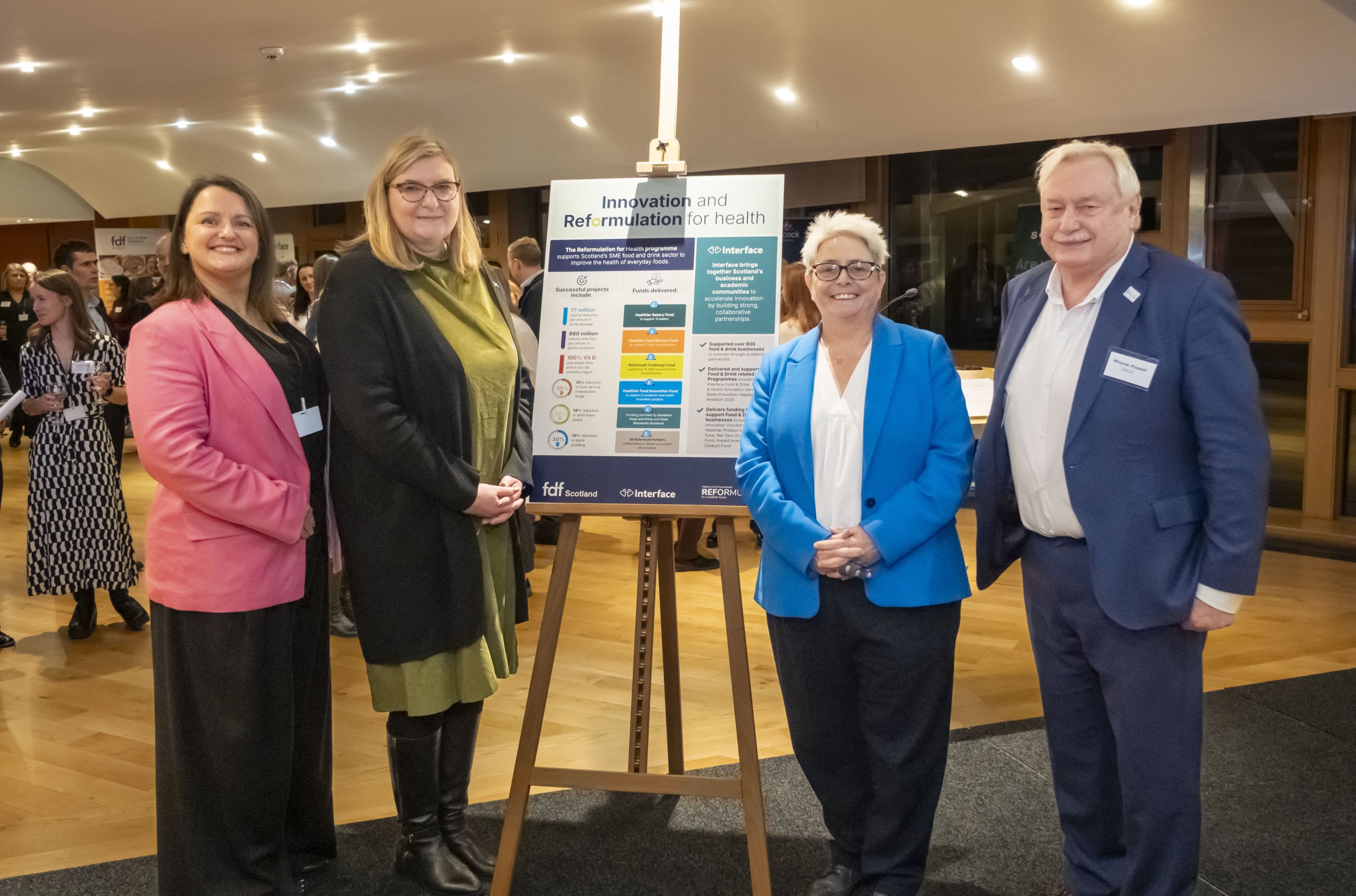
Scotland’s food and drink sector is under growing pressure to deliver healthier products while remaining competitive and compliant. Together with FDF Scotland we hosted a tasting event at the Scottish Parliament to showcase the innovative work that is being undertaken to reformulate products for health.
In addition to the delicious food & drink samples on offer the room was full of people committed to improving the health of Scotland’s products and population, from industry pioneers to support organisations and academic partners. Speakers Annie Wells MSP, Jenni Minto MSP and Minister for Public Health and Women’s Health, Professor Wayne Powell, Principal and Chief Executive of Scotland’s Rural College (SRUC) and Chair of Interface’s Strategic Board, and Joanne Burns, FDF Scotland, all recognised Scotland’s wealth in food and drink and the fantastic work that is underway. But there was acknowledgment that there is a huge opportunity to do more. Reformulation is no longer a niche activity or a response to isolated health concerns. It is becoming a core driver for food and drink businesses that want to remain competitive, compliant and relevant as expectations around health, nutrition and sustainability continue to rise.
Why academic support matters
Reformulating and developing products requires insight, testing and a deep understanding of nutrition, consumer behaviour and food systems. For many businesses, particularly SMEs, building this capability in-house is neither practical nor cost-effective particularly in the early stages. Scotland’s universities, colleges and research institutes provide access to specialist expertise, facilities and validation as well as the transfer of knowledge and expertise back into the business for future endeavours.
Crucially, academic partnerships can reduce both the time and risk involved in innovation, allowing businesses to test, validate and refine products before committing to full-scale production or market launch.
These partnerships don’t just support individual businesses, they strengthen Scotland’s entire innovation ecosystem. By connecting industry challenges with academic capability, we accelerate the pace of change and ensure that healthier products are grounded in robust research. The presence of Abertay University, Queen Margaret University, SRUC amongst our exhibitors with attendees from other universities and colleges on the evening was a reminder of how essential these relationships are and how much potential there is when industry and academia work side by side.
Celebrating our suppliers
The exhibitors’ food samples offered fantastic examples of Scottish products that have already undergone successful reformulation. Nairn’s, Saltsmith, Peacock Salt, LoSalt and Taylors Snacks showcased products with reduced fat and salt content across their ranges. Growers Garden demonstrated their mission to tackle food waste through their vegetable crisps, which have already been reformulated twice to further cut sugar and salt. Tempo Tea Bar and Three Robins also highlighted how they have lowered sugar content through reformulation work.
Several samples had also been produced through academic partnerships to support their innovation and reformulation journeys. The Prebiotic Company, for example, collaborated with Glasgow Caledonian University to validate the efficacy of their ió fibre water, which contributes to daily fibre intake.
With the impending HFSS regulations coming into play in Scotland this year, there are challenges for manufacturers to meet compliance but it also provides growth opportunities in existing categories as well opening access to new markets such as schools and NHS settings and strengthens long-term resilience.
What’s next?
The examples highlighted above have been supported by Interface and the Reformulation for Health Programme hosted by FDF Scotland, with support and delivery of funding programmes such as the Reformul8 Challenge Fund, Heathier Products Innovation Fund and Innovation Vouchers, which are funded by Scottish Government, Scotland Food & Drink and the Scottish Funding Council. The work already carried out has helped build momentum and significant impacts and reductions in calories and salt levels were highlighted throughout the evening.
However, current levels of funding and engagement will not be sufficient to meet demand or scale impact. Without continued focus and investment, progress will stall.
Interface works with businesses to connect them to the academic expertise, facilities and funding needed to turn reformulation ambition into action. We encourage organisations across Scotland’s food and drink sector to engage with us and explore the support available. Contact us.
The photo above shows from left Joanne Burns, Jenni Minto MSP, Annie Wells MSP and Professor Wayne Powell.